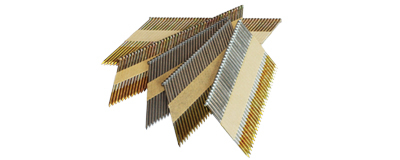
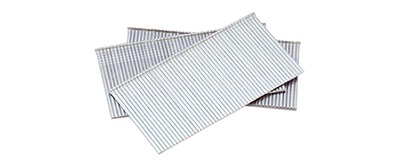
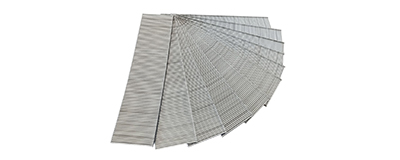
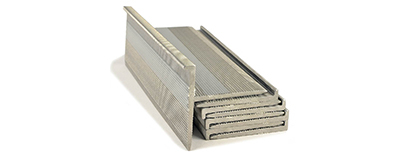
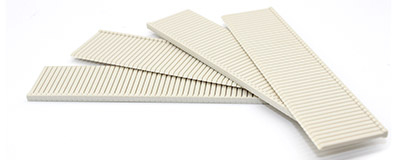
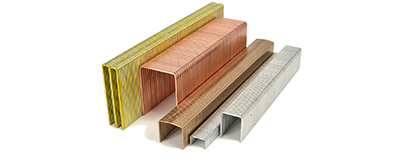
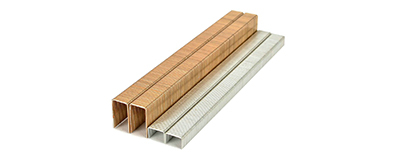
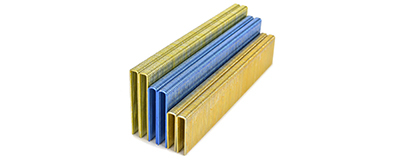
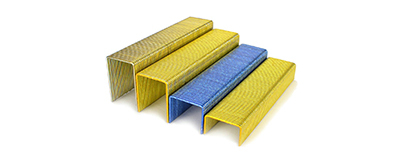
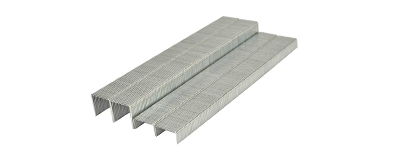
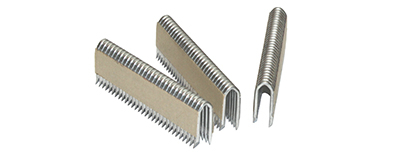
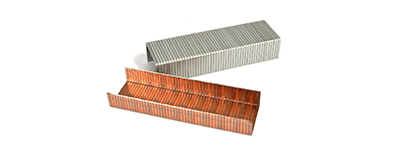
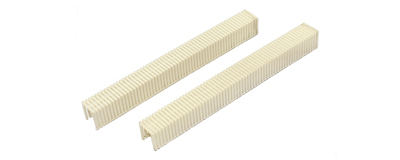
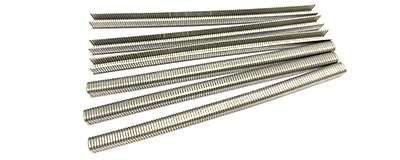
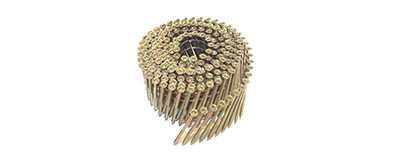
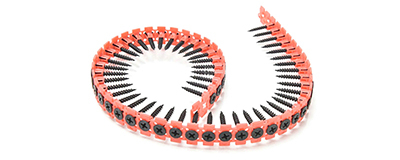
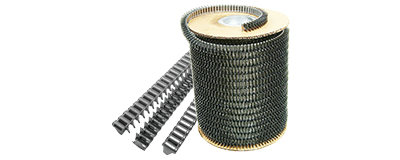
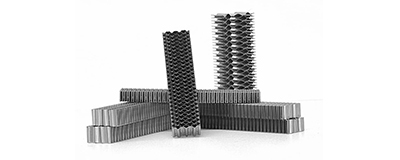
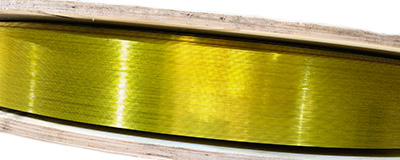
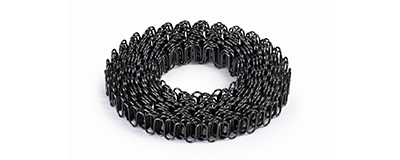
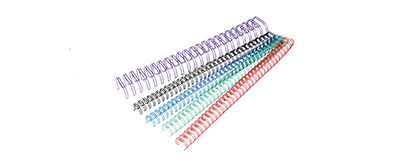
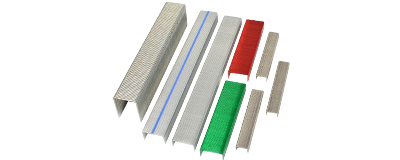
KYA 1306 polymer composite staples are 19 gauge non-metal fasteners with a 12.7mm / 1/2" crown and 6mm leg length. They are designed for industrial applications where conventional steel staples may create rust, electrical conductivity, metal contamination or problems during later cutting and finishing operations.
The 13 Series staple profile uses an approximately 1.30mm width and 1.20mm thickness with a smooth profile and glue collation. KYA lists the 1306 configuration at 5,040 staples per box and 40 boxes per carton.
Typical applications include lumber wrap, lumber tagging, house wrap, radiant barrier installation, fiberglass lay-up, composite manufacturing, boatbuilding, casket lining, casegoods tagging and other manufacturing processes where a non-metal staple is preferred.
| Product Type | Polymer Composite Staple / Plastic Staple / Non-Metal Staple |
| Model | 1306 |
| Series | 13 Series |
| Gauge | 19 Gauge |
| Material | Polymer Composite |
| Crown Width | 12.7mm / 1/2" |
| Leg Length | 6mm / approximately 1/4" |
| Staple Width | 1.30mm |
| Staple Thickness | 1.20mm |
| Shank / Leg Profile | Smooth |
| Collation | Glue Collated |
| Metal Content | Non-Metal Polymer Composite |
| Standard Packing | 5,040 pcs / box |
| Boxes per Carton | 40 boxes |
| Carton Size | Approximately 35.5 × 23 × 23.5cm |
| Primary Applications | Lumber wrap, tagging, house wrap, radiant barrier, composites, fiberglass lay-up and non-metal fastening |
Unlike conventional steel staples, the 1306 is manufactured from polymer composite material. This makes the fastener suitable for production environments where exposed or embedded metal can interfere with downstream cutting, sanding, planing, scanning or finishing operations.
Polymer composite staples contain no conventional steel staple wire. They are used where metal contamination, rust marks or electrically conductive fasteners are undesirable.
Because the staple is made from polymer composite rather than steel, it does not develop the red rust associated with ordinary carbon-steel staples. This can be useful in lumber processing, wrapping, marine composite work and other applications where metal corrosion may stain the workpiece.
Polymer composite fasteners can remain in many workpieces during later sawing, sanding, shaping and planing operations. This is particularly useful in wood products and composite manufacturing where hidden metal fasteners could otherwise contact cutting or finishing equipment.
Actual compatibility with blades, knives and machining equipment depends on the polymer grade, cutter material, machine speed and production process. Validate the fastener with the intended tooling before full-scale production.
The non-metal polymer composite material is useful in selected applications where an electrically conductive steel staple is not preferred. Electrical performance should still be evaluated as part of the complete assembly when insulation properties are critical.
Because the fastener is non-metal, polymer composite staples are commonly used in production environments where conventional metal staples could trigger metal-detection equipment. Detector sensitivity and the complete packaged product should be validated by the user.
Polymer composite staple systems are often described as developing a glue-like interface with compatible materials. Final holding performance depends on staple length, substrate density, material thickness, tool setup and installation conditions.
The 6mm leg length is intended for relatively thin fastening assemblies where a 12.7mm crown 19 gauge polymer staple provides sufficient engagement. Select staple length according to the material thickness and holding requirement.
Lumber wrap fastening
Lumber tagging
House wrap installation
Radiant barrier installation
Fiberglass lay-up
Composite manufacturing
Boatbuilding and marine composite work
Casket lining
Casegoods tagging
Woodworking where later cutting or sanding is required
Selected packaging and non-metal fastening operations
For load-bearing, structural, safety-critical or exterior building applications, confirm that the polymer fastener and 6mm leg length meet the requirements of the complete assembly before use.
Lumber production is one of the established applications for polymer composite staples. Non-metal fasteners can remain in wrapping or tagging materials without introducing a conventional steel staple into lumber that may later be sawn, planed or otherwise processed.
The 1306 has a 6mm leg, making it one of the shorter fasteners in the KYA 13 Series. Where more penetration is needed, longer 1308, 1310 or 1314 staples can be considered after checking tool capacity and material thickness.
Composite staples can be used as temporary or permanent fastening aids during fiberglass lay-up and other composite manufacturing operations where embedded steel fasteners are undesirable.
The suitability of the 1306 size depends on the lay-up thickness, tooling, resin system and manufacturing process. Perform application testing when the staple will remain embedded in the finished component.
KYA 13 Series staples use the same 12.7mm / 1/2" crown and are offered in multiple leg lengths. The 1306 shown on this page has a 6mm leg.
| Model | Crown | Leg Length | Pcs / Box | Boxes / Carton | Carton Size |
|---|---|---|---|---|---|
| 1304 | 12.7mm / 1/2" | 4mm | 5,040 | 40 | 36 × 16 × 23.5cm |
| 1306 | 12.7mm / 1/2" | 6mm | 5,040 | 40 | 35.5 × 23 × 23.5cm |
| 1308 | 12.7mm / 1/2" | 8mm | 5,040 | 40 | 36 × 29 × 23.5cm |
| 1310 | 12.7mm / 1/2" | 9.5mm | 5,040 | 40 | 35.5 × 34 × 24cm |
| 1314 | 12.7mm / 1/2" | 14mm | 5,040 | 40 | 46.5 × 39.5 × 24.5cm |
Select the staple leg according to the thickness of the material being attached, the receiving material and the amount of penetration required. A longer leg is not automatically the better choice.
| Selection Point | What to Check |
|---|---|
| Attached Material Thickness | Ensure sufficient staple leg remains for engagement after passing through the wrap, fabric, barrier or composite layer. |
| Receiving Material | Wood density and composite structure affect penetration and holding performance. |
| Tool Capacity | The stapler must accept the 19GA polymer staple profile and selected leg length. |
| Post-Processing | Consider whether the workpiece will later be sawn, routed, sanded, planed or scanned. |
| Holding Requirement | Test the selected length in the actual material when retention requirements are important. |
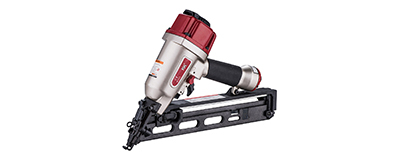
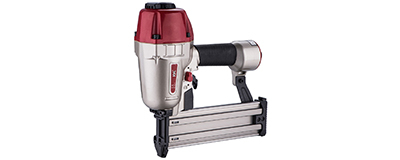
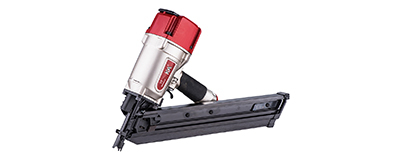
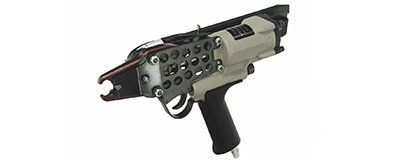
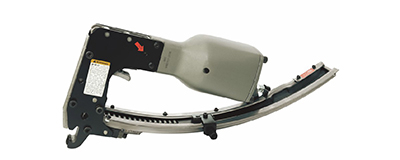
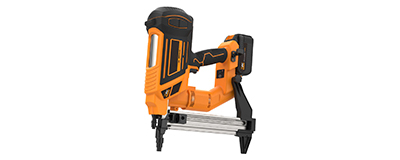
Polymer composite staples require staplers designed around their specific crown, cross section and strip geometry. A conventional 19 gauge metal stapler should not automatically be assumed to accept a polymer composite staple.
The Omer 81P is a useful reference tool because its published specification covers 19 gauge polymer composite staples with a 12.7mm crown and approximately 6–16mm leg range. Spotnails also offers dedicated 19 gauge composite-staple tools within its S19/12 system.
| Reference Tool / System | Published Composite Staple Format | Ordering Note |
|---|---|---|
| Omer 81P Series | 19GA, 12.7mm crown, approximately 6–16mm polymer staples | Strong dimensional reference; confirm strip profile before using KYA 1306 |
| Spotnails PS8914C | 19GA, 1/2" crown composite staple system | Compare exact width, thickness, strip geometry and 6mm leg |
| Spotnails MT19/12 | 19GA, 1/2" crown composite staples | Confirm exact fastener dimensions before use |
| Other Polymer Staplers | Must accept 19GA, 12.7mm crown and the KYA 13 Series profile | Provide manufacturer and model for compatibility confirmation |
Do not select a stapler solely because it is labeled 19 gauge or 1/2" crown. Metal staples and polymer composite staples can use different cross sections, strip geometry and feed requirements.
| Feature | Polymer Composite Staple | Conventional Steel Staple |
|---|---|---|
| Material | Non-metal polymer composite | Steel or other metal |
| Rust | Does not develop steel rust | Depends on metal and coating |
| Electrical Conductivity | Non-metal material | Metal is electrically conductive |
| Sawing / Sanding / Planing | Designed for downstream processing with suitable tooling | Hidden metal may contact cutters or abrasives |
| Metal Detection | Used where a non-metal fastener is preferred | Can be detected as metal |
| Tool Requirement | Dedicated or compatible composite-staple tool | Tool matched to the specific metal staple series |
For accurate quotation and tool matching, provide the required quantity, stapler manufacturer and model, application, attached material, receiving material and delivery destination.
For this product, specify 19 Gauge KYA 1306 polymer composite staple, 12.7mm crown × 6mm leg, 1.30mm width, 1.20mm thickness.
| Model | 1306 |
| Series | 13 Series |
| Gauge | 19 Gauge |
| Crown | 12.7mm / 1/2" |
| Leg Length | 6mm |
| Width × Thickness | 1.30 × 1.20mm |
| Material | Polymer Composite |
| Collation | Glue Collated |
| Packing | 5,040 pcs / box; 40 boxes / carton |
| Carton Size | Approximately 35.5 × 23 × 23.5cm |
| Inquiry Information | Quantity, stapler model, application, attached material, receiving material and destination |
The KYA 1306 is a 19 gauge polymer composite staple with a 12.7mm / 1/2" crown and 6mm leg length.
The KYA 13 Series profile is approximately 1.30mm wide × 1.20mm thick.
No. The KYA 1306 is manufactured from non-metal polymer composite material.
They do not develop the steel rust associated with conventional carbon-steel staples because the staple itself is non-metal polymer composite.
Yes. Polymer composite fasteners are specifically used in applications where the workpiece may later be cut, sanded or planed. Tooling and fastener material should still be validated for the actual production process.
The staple itself is non-metal, which is why polymer composite fasteners are commonly selected for metal-detector-sensitive applications. Verify the complete finished product with the actual detector settings used in production.
Polymer composite staples are non-metal and are used where conductive steel staples are undesirable. For electrical insulation or safety-critical applications, evaluate the complete assembly against the required electrical specification.
Typical uses include lumber wrap, lumber tagging, house wrap, radiant barrier installation, fiberglass lay-up, composite manufacturing, boatbuilding, casket lining and casegoods tagging.
Yes, house wrap is a documented application for 19 gauge polymer composite staple systems. Confirm that the 6mm leg length is suitable for the wrap and receiving substrate.
Yes. Fiberglass lay-up and composite manufacturing are established uses for polymer composite fasteners where embedded metal is undesirable.
Use a stapler designed for 19 gauge, 12.7mm / 1/2" crown polymer composite staples and a 6mm leg. Omer 81P-type polymer staplers are a relevant dimensional reference, but the exact staple cross section and strip geometry should be confirmed before use.
Do not assume compatibility. The BeA 380/14-450 is specified for the BeA Type 380 metal staple system, which uses a different fastener profile from 19 gauge polymer composite staples.
KYA lists 5,040 staples per box and 40 boxes per carton for the 1306 configuration.
The 13 Series includes 4mm, 6mm, 8mm, 9.5mm and 14mm leg lengths under the 1304, 1306, 1308, 1310 and 1314 model references.
Provide the required quantity, stapler manufacturer and model, application, attached material, receiving material and delivery destination. Specify KYA 1306, 19 gauge, 12.7mm crown and 6mm leg for the product shown on this page.