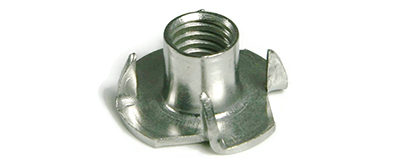
KYA 3/8-16 T-Nuts are zinc-plated carbon-steel threaded inserts designed to create a reusable female thread in wood, plywood, particle board and other suitable wood-based panels. The four-prong flange bites into the material to help resist rotation when a matching 3/8-16 bolt is tightened.
The featured product uses a 3/8-16 UNC coarse thread, four-prong design and zinc-plated carbon-steel construction. Typical applications include furniture assembly, plywood panels, speaker cabinets, equipment mounting, woodworking fixtures and selected climbing-wall installations where the complete hardware system specifies a 3/8-16 T-nut.
For accurate replacement or project specification, buyers should confirm not only the 3/8-16 thread but also the barrel diameter, barrel length, flange diameter, flange thickness and required mounting-hole diameter. These dimensional details are not included in the available product data and should be confirmed before bulk purchasing.

| Specification | Details |
|---|---|
| Product Type | Four-Prong T-Nut / Tee Nut / Threaded Insert for Wood |
| Thread Size | 3/8-16 UNC |
| Nominal Thread Diameter | 3/8 inch |
| Threads per Inch | 16 TPI |
| Thread Series | UNC / Unified National Coarse |
| Material | Carbon Steel |
| Finish | Zinc Plated |
| Prong Count | 4 Prongs |
| Thread Type | Coarse Thread |
| Barrel Diameter | Not specified in the available product data; confirm the production drawing before selecting the drill-hole diameter |
| Barrel Length | Not specified in the available product data; confirm the current production drawing |
| Flange Diameter | Not specified in the available product data; confirm the current production drawing |
| Flange Thickness | Not specified in the available product data; confirm the current production drawing |
| Recommended Hole Diameter | Match the drill-hole diameter to the actual KYA barrel diameter and production drawing |
| Typical Base Materials | Wood, Plywood, Particle Board and other suitable wood-based panels |
A T-nut is a threaded insert used to add an internal machine thread to wood or another suitable panel material. The cylindrical barrel fits into a drilled hole while the flange remains against the surface of the panel.
On a four-prong T-nut, four pointed tabs extend from the flange. When the T-nut is installed into the wood, the prongs embed in the panel and help prevent the insert from turning when a matching bolt is tightened.
The designation 3/8-16 means the internal thread has a nominal 3/8-inch major diameter and 16 threads per inch. A mating fastener must use the same 3/8-16 thread specification.
A T-nut allows a machine bolt to be repeatedly installed and removed without cutting the bolt thread directly into the wood. This makes the fastener useful for knock-down furniture, removable panels, equipment mounts and assemblies that may require later servicing.
The four-prong flange mechanically engages the wood around the mounting hole. When installed correctly, the prongs help keep the insert from rotating as the mating 3/8-16 bolt is tightened.
The flange gives the T-nut a larger bearing surface than a simple threaded barrel. Actual load capacity depends on flange dimensions, wood type, panel thickness, installation direction and applied load.
This KYA product uses zinc-plated carbon steel. Zinc plating provides additional corrosion protection compared with untreated carbon steel, but it should not be treated as equivalent to stainless steel for permanently wet, coastal or chemically aggressive environments.
| Thread Marking | Meaning |
|---|---|
| 3/8 | Nominal thread diameter in inches |
| 16 | 16 threads per inch |
| UNC | Unified National Coarse thread series |
| Matching Bolt | Use a bolt or threaded component with the same 3/8-16 thread |
| Metric Equivalent? | No direct interchange. A 3/8-16 UNC thread should not be replaced by an M10 thread even though the nominal diameters are relatively close. |
3/8-16 and M10 are different thread systems. A 3/8-16 T-nut uses an imperial UNC thread, while an M10 T-nut uses a metric thread with a specified metric pitch such as M10×1.5.
| Feature | 3/8-16 T-Nut | M10 T-Nut |
|---|---|---|
| Measurement System | Imperial / Inch | Metric |
| Thread Identification | 3/8-16 UNC | M10 plus specified thread pitch |
| Interchangeable? | No. Match the bolt and nut to the same thread system. | |
| Common Purchasing Markets | North American imperial-thread applications and other 3/8-16 systems | Metric-thread applications |

3/8-16 T-nuts can create reusable threaded connections in furniture frames, tables, benches, seating and other wood assemblies where a matching machine bolt is preferred over a wood screw.
The four-prong design can be installed in suitable plywood and engineered wood panels. Panel thickness, edge distance, material density and hole diameter should be checked to reduce the risk of splitting, breakout or poor prong engagement.
T-nuts are commonly useful in speaker cabinet construction because they provide a reusable machine thread for mounting drivers, panels and other components that may need to be removed for service.
A 3/8-16 threaded insert can also be used with compatible threaded stems, brackets and equipment mounts where the wood panel and hardware design are suitable for a pronged T-nut.
3/8-16 is widely used as a U.S. climbing-hold bolt thread. For climbing-wall use, however, do not select the T-nut by thread size alone. Confirm the wall-panel specification, T-nut flange and barrel dimensions, bolt specification, installation method and applicable climbing-wall hardware requirements.
Measure or obtain the actual KYA T-nut barrel diameter before drilling. The mounting hole must allow the barrel to enter without excessive clearance. Select the drill size from the actual barrel dimensions rather than assuming another 3/8-16 T-nut uses the same hole size.
Drill through the panel at the required location. A clean, perpendicular hole helps the T-nut barrel and mating bolt remain aligned.
Insert the barrel into the drilled hole with the four prongs facing the wood surface that will retain the flange. Check that all four prongs contact the panel evenly.
Seat the T-nut squarely so the prongs enter the wood without tilting the barrel. Installation method should suit the panel material and T-nut geometry.
Use a mating 3/8-16 bolt of suitable length. Start the bolt carefully to avoid cross-threading and tighten according to the requirements of the finished assembly.

Thread size alone is not enough to specify a T-nut. Different manufacturers can use different barrel lengths, barrel diameters, flange dimensions and prong geometry while still using the same 3/8-16 internal thread.
| Dimension to Confirm | Why It Matters |
|---|---|
| Internal Thread | Must match the mating 3/8-16 bolt |
| Barrel Diameter | Determines the required mounting-hole diameter |
| Barrel Length | Must suit panel thickness and required thread engagement |
| Flange Diameter | Controls bearing area and may affect available installation space |
| Flange Thickness | Affects installed height and assembly geometry |
| Prong Length and Position | Affects engagement with plywood, particle board and solid wood |
| Panel Thickness | The panel must provide enough material to support the barrel and prong engagement |
Some 3/8-16 four-prong T-nuts in the market use approximately a 1-inch flange and a 7/16-inch barrel length, but dimensions vary by manufacturer. Use these values only as general references and confirm the actual KYA barrel and flange dimensions before replacement, drilling or bulk ordering.
Zinc plating provides a protective surface on carbon steel and is widely used for furniture, cabinetry and general woodworking hardware. It offers more corrosion protection than untreated plain steel in normal indoor conditions.
Zinc-plated carbon steel should not automatically be described as suitable for permanent exterior exposure. Moisture, condensation, salt and chemicals can increase corrosion. For permanently wet, coastal or highly corrosive environments, confirm whether stainless steel or another corrosion-resistant specification is required.
| Material | General Corrosion Resistance | Typical Selection |
|---|---|---|
| Zinc-Plated Carbon Steel | Suitable for many normal dry indoor conditions and occasional moisture depending on coating specification | Furniture, cabinetry, speaker cabinets, plywood fixtures and general woodworking |
| Stainless Steel | Higher corrosion resistance than standard zinc-plated carbon steel | Wet, exterior or corrosion-sensitive applications where the specified stainless grade is appropriate |
| Feature | Four-Prong T-Nut | Screw-In Threaded Insert |
|---|---|---|
| Installation | Barrel enters a drilled hole and flange/prongs seat against the panel | External insert thread is screwed into a prepared hole |
| Anti-Rotation Method | Four prongs bite into the wood | External insert threads engage the wood |
| Rear Access | Common installation places the flange on the opposite side of the bolted component | Can often be installed from one accessible face |
| Selection | Useful for plywood panels, furniture and assemblies designed around a flange-backed threaded insert | Useful when screw-in installation or a different insert geometry is preferred |
3/8-16 is a common U.S. thread size for bolt-on climbing holds and climbing-wall hardware. However, climbing-wall systems can use different T-nut base designs, barrel lengths and installation methods.
For climbing-wall construction, confirm that the specific T-nut design is appropriate for the wall panel and hold system. Do not rely only on the fact that the internal thread is 3/8-16. Follow the climbing-wall or hold manufacturer's installation requirements for panel thickness, bolt length, T-nut placement and hardware condition.
| Selection Factor | What to Check |
|---|---|
| Thread | Confirm the mating bolt is 3/8-16 UNC |
| Panel Material | Solid wood, plywood and particle board have different density and prong-holding characteristics |
| Panel Thickness | Ensure the panel is suitable for the selected barrel length and mounting arrangement |
| Hole Diameter | Match the drilled hole to the actual T-nut barrel diameter |
| Flange Diameter | Confirm enough installation area is available around the hole |
| Environment | Select zinc-plated steel or another material according to moisture and corrosion exposure |
| Load and Safety Requirement | Furniture, machinery mounts and climbing-wall applications can have different load and safety requirements |
| Ordering Information | What to Provide |
|---|---|
| Thread | 3/8-16 UNC |
| Material | Zinc-Plated Carbon Steel |
| Prong Type | Four-Prong |
| Barrel Diameter | Provide required dimension or request current KYA production drawing |
| Barrel Length | Specify according to panel thickness and application |
| Flange Diameter | Specify if replacement compatibility depends on the existing T-nut footprint |
| Application | Furniture, plywood, speaker cabinet, caster mounting, climbing wall or other woodworking application |
| Panel Material and Thickness | Provide wood type and thickness when installation compatibility needs to be checked |
| Mating Bolt | Confirm 3/8-16 bolt and required bolt length |
| Quantity | Boxes, cartons, pallets or annual purchasing volume |
Send Your 3/8-16 T-Nut Requirements
The current KYA specification lists a 3/8-16 UNC coarse internal thread.
3/8 indicates the nominal thread diameter in inches, while 16 indicates 16 threads per inch. The matching bolt must also use a 3/8-16 thread.
No. 3/8-16 UNC and M10 are different thread standards and are not directly interchangeable. Match the T-nut to the exact bolt thread.
The current product specification lists zinc-plated carbon steel.
The product uses a four-prong flange. The prongs engage the wood to help resist rotation during bolt installation.
The exact barrel diameter and recommended drill size are not included in the available product data. Confirm the current production drawing or measure the supplied barrel before selecting the drill bit. Do not assume every 3/8-16 T-nut uses the same mounting-hole diameter.
3/8-16 defines the internal thread, not the outside diameter of the T-nut barrel. Different manufacturers can use different barrel dimensions, so the recommended mounting-hole size can vary.
Yes, plywood is listed among KYA's intended materials. Confirm panel thickness, hole diameter and prong engagement before production installation.
These T-nuts can be used in suitable particle board. Because engineered boards can vary substantially in density and edge strength, test the actual panel and avoid placing the insert too close to an unsupported edge.
Yes. T-nuts are commonly used to create removable threaded joints in furniture, benches, tables, seats and other wood assemblies.
Yes. KYA lists loudspeaker boards as an application. T-nuts can provide a reusable internal thread for mounting speaker drivers and other removable cabinet components.
3/8-16 is a common U.S. climbing-hold thread size, but suitability depends on the complete climbing-wall hardware system. Confirm wall-panel thickness, T-nut dimensions, bolt specification and installation requirements rather than selecting solely by thread size.
Do not treat zinc-plated carbon steel as a universal outdoor specification. It provides corrosion protection for many normal environments, but persistent moisture, salt or chemicals may require stainless steel or another specified corrosion-resistant material.
A conventional four-prong T-nut uses pointed tabs to engage the wood. Some climbing-wall systems use round or rectangular base T-nuts secured with separate screws. Both may use 3/8-16 threads, but their mounting geometry and installation method are different.
Use a bolt with a matching 3/8-16 UNC thread. Bolt length depends on the thickness of the attached component, panel thickness and required thread engagement.
No. A 3/8-16 T-nut requires a 3/8-16 bolt. A 3/8-inch fine-thread bolt with a different threads-per-inch value will not have the correct thread pitch.
Contact KYA Fasteners to confirm current sample availability. For replacement or production applications, test the actual T-nut with the intended 3/8-16 bolt, drilled hole and wood panel before bulk purchasing.
KYA supplies T-nuts for fastener distributors, furniture manufacturers, woodworking suppliers, speaker-cabinet manufacturers, hardware wholesalers and other industrial buyers.
For quotations on 3/8-16 four-prong zinc-plated T-nuts, provide the required barrel dimensions, flange dimensions, panel material and thickness, mating bolt specification, application, quantity, packaging requirement and destination market.