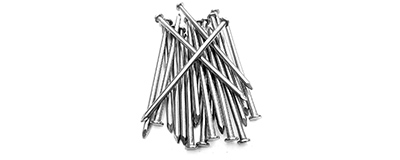
KYA galvanized common nails are bulk loose steel nails for general construction, carpentry, wood framing, pallet and crate manufacturing, timber formwork and other wood-to-wood fastening applications.
A conventional common nail has a flat round head, round smooth shank and diamond point. Compared with thinner box or finish nails, the heavier common-nail shank is intended for applications where greater fastener cross section and holding capacity are required.
KYA lists common nail lengths from approximately 1 inch to 6 inches / 25–150 mm, with multiple diameters and penny sizes. Bright, electro-galvanized and hot-dip galvanized surface options are available within the product range, together with different bulk packing configurations.

Flat round head: provides a broad bearing surface against the wood.
Diamond point: conventional point geometry for hand driving into suitable timber and wood products.
Round steel shank: standard common-nail construction for general carpentry and framing.
Multiple lengths: KYA lists approximately 1–6 inch / 25–150 mm sizes.
Multiple diameters: shank and head dimensions vary according to penny size and nail length.
Surface options: bright, electro-galvanized and hot-dip galvanized configurations are available within the range.
Shank options: smooth common nails are standard, with ringed or spiral/twisted variants available for applications requiring a different withdrawal-resistance profile.
Bulk packing: 50 lb, 25 kg and 20 kg packing formats are listed for suitable order configurations.
| Parameter | Available Specification |
|---|---|
| Product Type | Bulk Loose Common Nails / Round Wire Nails |
| Base Material | Steel |
| Head | Flat Round Head |
| Point | Diamond Point |
| Standard Shank | Round Smooth Shank |
| Alternative Shank Options | Ring, Spiral / Screw or Twisted, subject to required configuration |
| Length Range | Approximately 1–6 inches / 25–150 mm |
| Surface Options | Bright, Electro-Galvanized, Hot-Dip Galvanized and other specified finishes |
| Bulk Packing Options | 50 lb carton, 25 kg box or 20 kg box, according to order configuration |
| Fastener Standard | ASTM F1667 configuration available according to specified nail dimensions |
| HDG Coating Reference | ASTM A153/A153M hot-dip galvanized coating requirements where specified |
Common nails are commonly identified by penny size together with length, shank diameter and head diameter. The following KYA steel-nail dimensions are useful reference sizes. Confirm the exact dimensions, tolerance, finish and applicable standard for the required order.
| Item No. | Penny Size | Length | Shank Diameter | Head Diameter | Material |
|---|---|---|---|---|---|
| KYAS-05 | 6d | 2" / 50 mm | 0.113" | 0.266" | Steel |
| KYAS-09 | 10d | 3" / 75 mm | 0.148" | 0.312" | Steel |
| KYAS-12 | 20d | 4" / 100 mm | 0.192" | 0.406" | Steel |
| KYAS-16 | 60d | 6" / 150 mm | 0.262" | 0.531" | Steel |

Common nails are frequently ordered using the traditional penny designation, shown with the letter d. Examples include 6d, 8d, 10d, 12d, 16d, 20d and 60d.
The penny designation should not be used by itself when ordering internationally because nail dimensions can differ between product families. Buyers should confirm length, shank diameter, head diameter, material and finish.
| Penny Size | KYA Length | General Selection Consideration |
|---|---|---|
| 6d | 2" / 50 mm | Shorter common-nail size for suitable carpentry and wood assemblies. |
| 10d | 3" / 75 mm | Common construction and framing size where the specified joint requires this length and diameter. |
| 20d | 4" / 100 mm | Longer and heavier common nail for suitable timber assemblies. |
| 60d | 6" / 150 mm | Large common-nail size for applications requiring a long, heavy steel fastener. |
| Finish | Description | Typical Selection |
|---|---|---|
| Bright Steel | Uncoated steel surface. | Dry interior or temporary applications where additional corrosion protection is not required. |
| Electro-Galvanized | Electroplated zinc coating. | General applications requiring more corrosion resistance than bright steel, subject to the actual exposure environment. |
| Hot-Dip Galvanized | Zinc coating applied by the hot-dip galvanizing process. | Exterior and treated-lumber applications where the required coating specification calls for hot-dip galvanized fasteners. |
| Stainless Steel | Corrosion-resistant stainless material option. | More demanding corrosive environments where the project specification requires stainless fasteners. Confirm exact grade and nail size. |
ASTM A153/A153M covers zinc coatings applied by the hot-dip process to iron and steel hardware. Where ASTM A153/A153M compliance is required, specify the hot-dip galvanized configuration and the required coating documentation when requesting a quotation.
Electro-galvanizing is a different zinc-coating process and should not be described as ASTM A153 hot-dip galvanizing.
ASTM F1667 covers driven fasteners including nails, spikes and staples and includes dimensional requirements for common-nail configurations.
When a project or distributor specification requires ASTM F1667, provide the required nail type, size, shank diameter, head diameter, finish and applicable standard revision so the requested product can be matched to the specification.
The conventional common nail uses a round smooth shank. Smooth-shank nails are widely used for general construction, framing, carpentry, packaging and other wood fastening where the specified nail size provides the required connection.
Smooth shanks generally require less driving resistance than heavily deformed shanks, which can be useful in hand-driven and general carpentry applications.
Ring-shank common nails use annular deformations around the shank to increase resistance to withdrawal from suitable wood substrates compared with a comparable smooth-shank configuration.
They are commonly considered for applications such as sheathing, flooring, decking or other assemblies where increased withdrawal resistance is required. The exact fastener must still meet the project specification.
Spiral or twisted shanks provide a different mechanical engagement with the wood than a conventional smooth shank and can provide additional withdrawal resistance in suitable timber applications.
Specify the actual shank style, timber type and application rather than treating smooth, ring and spiral nails as interchangeable.
| Fastener | General Characteristic | Typical Use |
|---|---|---|
| Common Nail | Heavier round shank with flat head and diamond point. | General construction, carpentry and framing. |
| Box Nail | Generally thinner than a common nail of comparable length. | Lighter wood assemblies where a smaller shank may help reduce splitting. |
Common nails normally use a flat head and heavy round shank. Sinker nails are a related construction fastener but can use different head geometry, shank diameter and surface treatment.
When a project specifies a particular nail type, do not substitute a common nail, sinker, box nail or framing nail solely because the overall length is similar.
Common nails are widely used in wood framing and general construction. The appropriate penny size, shank diameter, nail length, material and coating depend on the connection and applicable building or engineering specification.
For load-bearing construction, select the exact fastener required by the project drawing, code, connector manufacturer or structural specification. A generic common-nail description does not establish structural suitability for every joint.
Loose common nails can be used in suitable pallet, crate and wooden-packaging production where hand-driven or manually positioned nails are specified.
Pallet manufacturers should specify the required nail length, shank diameter, head diameter, shank type and surface finish according to the pallet design and service conditions.
Common nails can be used for suitable timber formwork and shuttering assemblies, including fastening wood members used to construct temporary concrete forms.
These common nails are wood fasteners and should not be confused with hardened concrete nails designed to be driven directly into concrete or masonry.
Galvanized common nails can be used for suitable timber fencing components where the nail size, coating and connection design meet the project requirements.
For attaching fencing wire or mesh directly to timber posts, a purpose-designed fencing staple may be more appropriate than a conventional common nail.

Bulk common nails are typically purchased by weight rather than by a fixed piece count because the number of nails per carton changes substantially with nail size and diameter.
| Packing Format | Use |
|---|---|
| 50 lb Carton | Bulk imperial-market packaging for distributors and construction supply channels. |
| 25 kg Box | Metric bulk packing for industrial and distributor orders. |
| 20 kg Box | Alternative metric packaging according to market and order requirements. |
| Order Item | Information to Provide |
|---|---|
| Penny Size | Example: 6d, 10d, 20d or 60d. |
| Length | Specify exact inch or millimeter length. |
| Shank Diameter | Specify required diameter or gauge. |
| Head Diameter | Specify where required by the application or standard. |
| Shank Type | Smooth, ring or specified spiral / twisted configuration. |
| Finish | Bright, electro-galvanized, hot-dip galvanized or specified stainless option. |
| Standard | Specify ASTM F1667 and/or applicable hot-dip coating requirement where required. |
| Packing | Specify 50 lb, 25 kg, 20 kg or required market packaging. |
| Application | Framing, carpentry, pallet, crate, timber formwork or other wood fastening. |
| Quantity | Provide required cartons, kilograms, metric tons or estimated annual demand. |
Discuss Your Common Nail Specification
A common nail is a general construction fastener typically made with a flat round head, round smooth shank and diamond point. It is widely used for carpentry, wood framing and general wood-to-wood fastening.
KYA currently lists common-nail lengths from approximately 1 inch to 6 inches / 25–150 mm. Exact shank and head dimensions vary by size.
The letter “d” is the traditional penny-size designation. The KYA reference shown on this page lists a 10d steel common nail at approximately 3 inches / 75 mm long with a 0.148-inch shank.
The KYA reference shown here lists 6d at approximately 2 inches / 50 mm long, with a 0.113-inch shank and 0.266-inch head.
The current KYA table lists 20d at approximately 4 inches / 100 mm long with a 0.192-inch shank and 0.406-inch head.
The KYA reference lists 60d at approximately 6 inches / 150 mm long, with a 0.262-inch shank and 0.531-inch head.
Box nails are generally thinner than common nails of similar length. Common nails use a heavier shank and are widely used for general construction and framing, while box nails are often selected for lighter wood assemblies.
Bright nails are uncoated steel. Galvanized nails have a zinc coating for additional corrosion protection. The appropriate finish depends on moisture exposure, timber treatment and project requirements.
Electro-galvanized nails receive zinc through an electroplating process. Hot-dip galvanized nails are immersed in molten zinc and use a different coating system. Select the required finish according to the application and specified corrosion protection.
ASTM A153/A153M addresses zinc coatings applied by the hot-dip process to iron and steel hardware. Electro-galvanizing is a different coating process.
ASTM F1667 is a specification covering driven fasteners including nails, spikes and staples. It includes dimensional requirements for defined fastener configurations, including common nails.
KYA lists ASTM F1667 as an applicable product standard. When compliance is required, provide the exact nail dimensions, finish and required standard revision so the correct configuration and documentation can be confirmed.
Hot-dip galvanized common nails are commonly specified for treated lumber where the applicable wood-treatment and project requirements permit hot-dip galvanized fasteners. Confirm the coating requirement for the actual preservative system.
Yes. Common nails are widely used for framing and general construction. Load-bearing applications should use the exact nail size and finish required by the applicable drawing, code or structural specification.
Yes, in suitable pallet, crate and wooden-packaging applications. Specify the required nail dimensions and shank style according to the packaging design.
They can be used for suitable timber members in formwork and shuttering assemblies. Common nails are not hardened concrete nails and should not be described as fasteners for direct driving into concrete.
Common nails can be used in timber fencing construction, but purpose-designed fencing staples are generally more appropriate for directly securing wire or mesh to wooden posts.
Ring-shank deformations can increase withdrawal resistance in suitable wood compared with a comparable smooth-shank nail. The actual performance depends on the nail geometry, wood species, moisture and connection design.
Spiral or twisted shanks increase mechanical engagement with the wood and can provide greater withdrawal resistance than a comparable smooth shank in suitable applications.
KYA currently lists stainless-steel common nail options, including 304 and 316 specifications. Confirm the required alloy, nail dimensions and availability when ordering.
For salt-air, marine-adjacent or chloride-rich environments, specify the required stainless grade according to the project and service environment rather than assuming every stainless formulation provides the same corrosion resistance.
KYA lists bulk packing options including 50 lb cartons, 25 kg boxes and 20 kg boxes. Confirm the required packaging and labeling format with the quotation.
The piece count depends on the nail's length, shank diameter and head size. Large 60d nails have far fewer pieces per unit weight than smaller 6d or 10d nails, so confirm the required size when calculating approximate count.
Provide the penny size or exact length, shank diameter, head diameter, shank style, material, surface finish, required standard, packaging, order quantity and destination market.
Ask About Galvanized Common Nails
KYA supplies bulk loose common nails from approximately 1 to 6 inches / 25–150 mm for fastener distributors, construction suppliers, timber-product manufacturers, pallet and crate producers and professional woodworking users. Specify the required size, shank, coating, standard, packing and quantity so the appropriate configuration can be confirmed.
The current product information lists a minimum order of one pallet (approximately 800–1,000 kg) or one 20-foot container, a free 5 kg sample box with freight paid by the buyer, and an estimated lead time of 15–25 days after deposit; rush orders may be available. Confirm the current MOQ, sample arrangement, production schedule and shipping terms when requesting a quotation.