KYA supplies T-nuts, also known as tee nuts or four-prong threaded nuts, for professional woodworking, furniture manufacturing and industrial wood panel assembly. These metal fasteners provide reusable internal threads in wood, plywood, MDF, particle board and other compatible panel materials.
Our T-nut range includes metric M5, M6, M8, M10 and M12 sizes, together with selected inch-thread models such as 1/4-inch and 3/8-inch T-nuts. KYA lists zinc-coated carbon steel four-prong T-nuts for applications requiring a threaded connection between wood components and compatible machine screws or bolts.
KYA works with furniture manufacturers, cabinet factories, woodworking businesses, industrial hardware distributors and building material importers. Buyers can select the appropriate T-nut according to thread size, barrel dimensions, flange geometry, panel thickness and installation requirements.
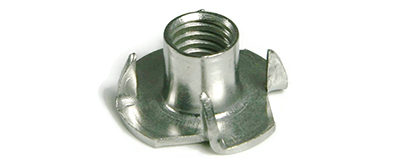
A T-nut is a metal fastener with an internally threaded barrel and a flat flange. Four-prong T-nuts have pointed projections extending from the flange to engage a wood or wood-based panel during installation.
The threaded barrel fits into a prepared mounting hole, while the prongs are embedded into the surrounding material. Once correctly seated, the T-nut provides a metal thread for a matching machine screw or bolt.
Unlike an ordinary wood screw that forms its own holding threads in the substrate, a T-nut provides a reusable machine-thread connection. This allows compatible components to be assembled, removed and reassembled without repeatedly cutting new threads into the wood.
The holding performance of a T-nut depends on the panel density, material thickness, mounting hole, flange and prong engagement, bolt tightening method and loading direction.
KYA's four-prong T-nuts are designed to establish threaded mounting points in compatible wood and wood-based panels. The four prongs extend from the flange and engage the workpiece to help prevent the nut from rotating when the mating bolt is tightened.
These fasteners are commonly used in furniture frames, cabinets, plywood panels, wooden fixtures, speaker enclosures and other assemblies requiring removable bolted connections.
KYA lists metric T-nuts in several nominal thread sizes, including M5, M6, M8, M10 and M12. Metric T-nuts are designed for compatible metric bolts and machine screws of the correct diameter and thread pitch.
The nominal M designation identifies the thread diameter, not the overall flange diameter or the size of the installation hole. Barrel dimensions, flange size and required mounting hole must be confirmed separately.
KYA also supplies selected inch-thread T-nuts for applications using imperial fasteners. The current category includes 1/4-inch and 3/8-inch T-nut products.
When sourcing inch-thread products, specify both nominal thread diameter and threads per inch. For example, a 1/4-inch T-nut should not be assumed compatible with every 1/4-inch threaded bolt without verifying the exact thread specification.
KYA lists zinc-coated carbon steel T-nuts for woodworking and furniture assembly. Zinc plating provides a protective surface that helps reduce corrosion under suitable service conditions.
For outdoor, continuously damp, chemically exposed or other corrosive environments, buyers should confirm the required coating specification and whether the selected product meets the application's corrosion-resistance requirements.
KYA offers T-nut products for different threaded fastening requirements. The table below summarizes representative sizes displayed in the current product category.
| Listed Size | Thread System | Selection Information |
|---|---|---|
| M5 | Metric | Includes a listed M5 × 8 mm four-prong model |
| M6 | Metric | Confirm thread pitch, barrel and flange dimensions |
| M8 / 8 mm | Metric | Confirm the exact model and installation dimensions |
| M10 | Metric | Check matching bolt and panel requirements |
| M12 | Metric | Verify flange, barrel and mounting clearance |
| 1/4" | Imperial | Confirm threads per inch and mating bolt |
| 3/8" | Imperial | Confirm threads per inch and complete nut dimensions |
Sizes in this table identify listed T-nut products. Exact thread pitch, barrel length, flange diameter, prong height and installation-hole dimensions depend on the individual model. Confirm these details before production purchasing.
Explore representative T-nut models from the KYA range. The individual product pages provide additional information about their specifications and applications.
| Product | Listed Specification | Details |
|---|---|---|
| M5 × 8 mm Four-Prong T-Nut | M5 internal thread, 8 mm listed length | View Product |
| 1/4-Inch T-Nut | Inch-thread T-nut | View Product |
| 3/8-Inch T-Nut | Inch-thread T-nut | View Product |
Selecting the correct T-nut requires more than matching its nominal thread size. The nut must fit the panel, accommodate the mating bolt and provide appropriate retention for the intended assembly.
| Specification | Description | Buyer Check |
|---|---|---|
| Internal Thread | Metric or imperial female thread | Match bolt diameter, pitch and thread standard |
| Barrel Diameter | Outside diameter of the threaded barrel | Confirm the appropriate drilled-hole diameter |
| Barrel Length | Axial length of the threaded body | Check panel thickness and available clearance |
| Flange Diameter | Outside diameter of the T-nut flange | Verify contact area and mounting clearance |
| Prong Height | Projection of the anchoring prongs | Match panel thickness and material density |
| Material | Carbon steel and model-specific material options | Confirm required strength and material specification |
| Surface Finish | Zinc coating or specified finish | Check corrosion-resistance requirements |
| Panel Material | Solid wood, plywood, MDF or particle board | Confirm prong retention and joint performance |
T-nut dimensions are not identical across manufacturers or product families. Always verify the dimensions required by your drawing, assembly or existing part before ordering replacement T-nuts.
Both four-prong T-nuts and threaded inserts provide reusable internal threads in wood, but their installation methods and retention designs differ.
| Feature | Four-Prong T-Nut | Screw-In Threaded Insert |
|---|---|---|
| Retention Design | Flange and anchoring prongs | External threads engaging the substrate |
| Installation | Inserted into a prepared hole and seated from the accessible side | Screwed into a prepared hole using a suitable driver |
| Access Requirement | Usually requires access to the reverse side of the panel | May be installed from the accessible face |
| Internal Thread | For compatible machine bolts or screws | For compatible machine bolts or screws |
| Selection Focus | Prong grip, flange and barrel dimensions | External thread, installation depth and substrate retention |
Choose the fastening method according to panel access, assembly design, expected load and whether the connection must be repeatedly disassembled.
Four-prong T-nuts are used in furniture components and bed frames where a machine bolt must connect a wooden panel or frame component. They create a reusable threaded mounting point for assembly, servicing or component replacement.
The T-nut and mating bolt must be selected according to the panel thickness, connection geometry and expected loading conditions.
T-nuts can provide metal internal threads in suitable plywood, MDF and particle board panels. Their prongs engage the workpiece around a drilled hole, allowing a machine screw or bolt to secure another component.
Panel density, edge distance and thickness affect installation quality and holding performance. For low-density or thin panels, verify that the prongs can be seated without splitting, tearing or weakening the substrate.
Furniture manufacturers and cabinet producers use threaded fastening systems for removable panels, furniture fittings and assembled components. T-nuts may be suitable where rear access is available and the design requires a machine-thread connection.
T-nuts are used in loudspeaker enclosures and audio equipment cabinets to provide reusable threaded mounting points for compatible speaker components, mounting hardware and wooden panels.
Select the nut dimensions according to the cabinet panel, mounting hole arrangement and required bolt engagement.
Four-prong T-nuts are commonly used in plywood climbing-wall panels to provide threaded mounting points for compatible climbing holds. They are normally positioned on the reverse side of the panel before the holds are attached with suitable bolts.
Climbing wall applications are load-critical. The selected nut, bolt, plywood panel and complete mounting assembly must meet the applicable safety and engineering requirements. Use the specified thread, hole dimensions and installation method for the approved climbing-wall system.
T-nuts can also be used in woodworking jigs, fixtures, workbenches and other compatible panel assemblies where removable metal-thread fastening points are required. Verify the connection requirements and suitable substrate before installation.
Correct installation helps the T-nut seat properly and provides suitable engagement with the workpiece. The mounting-hole diameter and seating method should always match the actual product dimensions.
Avoid excessive impact or tightening force that may damage the panel or cause the nut to rotate. For production applications, verify the installation method using the actual wood material, T-nut and bolt combination.
KYA lists carbon steel T-nuts with zinc-plated surfaces. The coating provides protection against oxidation and corrosion during suitable handling, storage and service conditions.
For standard interior furniture and woodworking applications, zinc-plated carbon steel is a commonly used material combination. However, actual corrosion resistance depends on the coating specification and working environment.
For outdoor installations, high humidity, salt exposure or chemically aggressive environments, specify the required corrosion performance and confirm a suitable product rather than assuming that standard zinc plating is sufficient.
KYA supplies T-nuts to furniture manufacturers, woodworking factories, hardware distributors, cabinet producers and industrial buyers sourcing threaded fastening components in bulk.
When ordering for a production line or purchasing replacement hardware, consistent dimensions are important for reliable assembly and compatibility with existing drilled panels and mating bolts.
For a quotation, please provide the following details:
If you need an equivalent to an existing T-nut, include the original part number, a dimensional drawing or a sample. KYA can review the requested specification and provide quotation information for the selected model.
Request a Wholesale T-Nut Quote
A four-prong T-nut is a metal fastener with an internally threaded barrel, a flange and four pointed prongs. It is installed into a prepared hole in a compatible wood panel to provide a reusable threaded connection for a matching bolt or machine screw.
KYA lists metric T-nuts in M5, M6, M8, M10 and M12 sizes, along with selected 1/4-inch and 3/8-inch products. Exact barrel, flange and prong dimensions depend on the selected model.
M8 identifies a nominal metric internal thread diameter of 8 mm. A product described as an 8 mm T-nut may refer to an M8 thread or another dimension, depending on the supplier. Confirm the exact thread pitch, barrel and flange specifications before assuming interchangeability.
Not unless the threads are specifically compatible. Metric and imperial thread systems may differ in diameter and pitch even when their nominal sizes appear similar. Always match the exact internal thread to the mating bolt.
A typical four-prong T-nut uses a flange and prongs to anchor in a wood panel, usually from the reverse side. A screw-in threaded insert uses external threads to engage the substrate. Both provide internal threads, but their installation and retention methods differ.
Yes, T-nuts can be installed in suitable plywood, MDF, particle board and other wood-based panels. Retention depends on panel density, thickness, installation-hole dimensions, prong engagement and loading conditions. Test the assembly before production use.
The drill hole must suit the outside diameter of the T-nut barrel and the installation specification. It is not determined solely by the nominal thread size. Confirm the required hole diameter for the actual product before drilling production panels.
Use the correct mounting-hole size, seat the flange and prongs properly, and ensure the wood is suitable for the required connection. Incorrect hole dimensions, damaged prongs, low-density panels or excessive tightening may cause the nut to rotate.
Yes. Four-prong T-nuts are commonly used in wooden furniture, bed frames, cabinets, benches and related assemblies where a reusable threaded connection is required. Select the nut according to the panel, bolt and joint design.
Four-prong T-nuts are used in suitable plywood climbing-wall panels. However, the fastener, bolt, mounting panel and completed climbing-wall assembly must meet the applicable engineering and safety requirements. Confirm the specified product dimensions and installation method before use.
Zinc plating provides corrosion protection, but outdoor suitability depends on coating specification, exposure conditions and expected service life. Standard zinc-plated carbon steel should not automatically be assumed suitable for permanently wet or highly corrosive environments.
Provide the thread size and pitch, barrel dimensions, flange diameter, prong configuration, material, finish, application, panel thickness, order quantity, packaging requirements and destination country. Include a drawing or sample when matching an existing T-nut.
FURNITURE ACCESSORIES
OFFICE SUPPLIES
PACKAGING MATERIAL