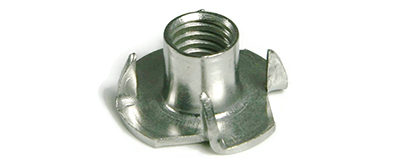
KYA M12 4 Prong T-Nuts, also called M12 tee nuts, prong nuts or threaded insert nuts for wood, are zinc-plated steel fasteners designed to create a reusable internal M12 threaded connection in plywood, particle board, furniture panels, loudspeaker boards and other suitable wood-based materials.
The four-prong flange bites into the back side of the panel to help resist rotation when a matching M12 bolt or machine screw is tightened. This makes the T-nut useful for furniture assembly, removable components, speaker enclosures, equipment panels, climbing-wall panels and other applications where repeated bolting into wood is required.

| Specification | Details |
|---|---|
| Product Name | M12 4 Prong T-Nut |
| Fastener Type | T-Nut / Tee Nut / Prong Nut / Wood Threaded Insert |
| Thread Size | M12 |
| Thread Pitch | Confirm required metric pitch when ordering |
| Prong Count | 4 Prongs |
| Material | Steel |
| Surface Finish | Zinc Plated |
| Installation | Press-In or Hammer-In Installation into a Pre-Drilled Wood Panel |
| Recommended Materials | Plywood, Particle Board, Wooden Panels, Furniture Components and Loudspeaker Boards |
| Typical Applications | Furniture, Speaker Boxes, Wood Assemblies, Removable Components and Compatible Climbing-Wall Panels |
When ordering M12 T-nuts, confirm the required thread specification, barrel dimensions, flange dimensions, panel thickness and matching bolt. The M12 thread designation alone does not determine every installation dimension.
A T-nut is a female threaded fastener designed to create a metal threaded connection inside wood or wood-based panel material. It consists of a threaded barrel and a flat flange with projecting prongs.
The barrel passes through a pre-drilled hole while the four prongs embed into the back side of the wood. Once installed, a matching bolt can be inserted from the opposite side and tightened into the metal thread instead of repeatedly threading directly into the wood.
This configuration is particularly useful when components need to be assembled, removed and re-installed multiple times.

The internal metric thread provides a reusable connection for a correctly matched M12 bolt or machine screw. This is useful in assemblies where the mating bolt may need to be removed for maintenance, transport or adjustment.
Four projecting prongs embed into the wood around the threaded barrel. Their purpose is to anchor the flange and help prevent the T-nut from rotating when the mating bolt is tightened.
Instead of relying on a wood screw thread cut directly into the panel, an M12 T-nut provides an internal metal thread that can support repeated bolt installation and removal in suitable assemblies.
The zinc-plated steel construction provides improved corrosion protection compared with untreated plain steel and is suitable for many furniture, woodworking and general indoor fastening applications.
When properly installed, the flange seats against the back side of the panel, keeping the threaded fastener compact and reducing interference with surrounding components.
M12 T-nuts can create removable threaded connections in suitable wooden furniture frames, tables, seating components, cabinets and other assemblies using metric bolts.
Four-prong T-nuts are commonly installed from the rear of plywood or particle-board panels where a reusable female thread is required. Panel thickness and density should be suitable for full prong engagement.
Speaker enclosures and loudspeaker mounting boards can use T-nuts where components are secured with machine screws or bolts and may later need to be removed for maintenance or replacement.
T-nuts can be used in compatible plywood climbing-wall systems to provide replaceable threaded attachment points for compatible hardware. The thread size, panel construction, bolt, hold and complete fastening arrangement must match the project requirements.
Equipment frames, sports equipment and wood-based machinery panels can use T-nuts where a removable metric threaded connection is required.
Other applications include jigs, fixtures, display stands, removable accessories and woodworking assemblies where direct wood-screw fastening is not preferred.

Confirm that the T-nut thread specification matches the bolt, machine screw or threaded component that will be installed.
Drill a straight hole sized for the T-nut barrel. The hole should allow the threaded barrel to pass through without excessive clearance while avoiding unnecessary damage to the wood.
Position the threaded barrel in the pilot hole from the rear of the wooden panel with all four prongs facing the surface.
Press or carefully hammer the flange until the prongs are seated evenly in the wood and the flange rests flat against the panel. Uneven installation can reduce anti-rotation performance.
Insert the matching bolt from the opposite side and tighten it into the metal thread. Avoid excessive tightening that could damage the panel or pull the T-nut through soft material.

| Selection Factor | What to Confirm |
|---|---|
| Thread Size | Match the T-nut thread to the required bolt or machine screw. |
| Thread Pitch | Confirm the exact metric thread specification required by the assembly. |
| Barrel Length | Select according to panel thickness and required thread engagement. |
| Barrel Diameter | Determines the required pilot-hole diameter. |
| Flange Diameter | Confirm that the flange provides sufficient contact area for the panel. |
| Prong Configuration | Four-prong designs provide multiple anchoring points around the flange. |
| Panel Material | Check wood density, plywood quality, particle-board density and panel thickness. |
| Surface Finish | Select according to indoor, humid, outdoor or corrosive service conditions. |
T-nuts and threaded inserts both create reusable metal threads in wood-based materials, but their installation methods and ideal applications are different.
| Feature | 4-Prong T-Nut | Screw-In Threaded Insert |
|---|---|---|
| Installation Side | Typically installed from the rear of the panel | Installed into the drilled hole from the accessible side |
| Anti-Rotation Method | Four prongs bite into wood | External insert thread engages the wood |
| Typical Use | Panels, furniture, speaker boxes and compatible climbing-wall panels | Furniture, fixtures and assemblies requiring a threaded insert |
| Reusable Bolt Connection | Yes | Yes |
Zinc plating helps protect steel T-nuts against oxidation and corrosion under many normal indoor and controlled-environment conditions.
For long-term outdoor exposure, coastal environments, persistent moisture or chemically aggressive conditions, the required corrosion resistance should be confirmed before ordering. A standard zinc-plated fastener should not automatically be treated as equivalent to a stainless-steel or specially coated outdoor fastener.
| Problem | Possible Cause | What to Check |
|---|---|---|
| T-Nut Spins When Bolt Is Tightened | Prongs not fully seated or damaged wood | Inspect prong engagement and panel condition |
| Barrel Does Not Fit the Hole | Incorrect pilot-hole diameter | Confirm barrel diameter before drilling |
| Prongs Split the Wood | Poor hole alignment, thin panel or installation too close to an edge | Review panel thickness, edge distance and installation method |
| Bolt Will Not Thread Smoothly | Mismatched thread or damaged internal thread | Confirm bolt specification and inspect threads |
| T-Nut Pulls Out of Panel | Insufficient prong engagement, weak substrate or excessive loading | Check wood density, panel thickness and load requirements |
Furniture factories, hardware distributors, woodworking companies and industrial buyers should provide complete dimensional and application information when requesting a quotation.
| Purchasing Information | Information to Provide |
|---|---|
| Thread Size | M12 |
| Thread Pitch | Specify required metric pitch |
| Barrel Length | Provide drawing or required dimension where applicable |
| Panel Material | Plywood, particle board, solid wood or other |
| Panel Thickness | Provide actual thickness |
| Finish | Zinc plated or required alternative |
| Quantity | Required pieces, cartons or annual volume |
| Packaging | Standard bulk packing, distributor labels or OEM requirements |
Send Your M12 T-Nut Requirements
M12 T-nuts create reusable internal metric threads in suitable wood panels. Typical applications include furniture, plywood assemblies, speaker boxes, equipment panels and compatible climbing-wall panel systems.
M12 identifies the nominal metric thread size. The mating bolt must use the corresponding thread specification.
The four prongs embed into the wood around the flange and help resist rotation when the mating bolt is tightened.
Yes. Plywood is one of the common materials used with four-prong T-nuts. Panel thickness and quality should provide sufficient engagement for the barrel and prongs.
They can be used in suitable particle board, but holding performance depends on board density, thickness, edge distance and the applied load. Test the intended assembly before production use.
Drill a correctly sized pilot hole, insert the threaded barrel from the rear side of the panel and press or hammer the flange evenly until all four prongs are fully seated.
Pilot-hole diameter depends on the actual outside diameter of the T-nut barrel, not simply on the M12 thread designation. Measure or confirm the barrel specification before drilling.
Use an M12 bolt or machine screw with the exact thread pitch specified for the T-nut. Confirm pitch before purchasing replacement bolts.
Common causes include incompletely seated prongs, damaged wood, an oversized pilot hole, weak panel material or excessive tightening torque.
Zinc plating improves corrosion resistance compared with untreated steel. For continuous outdoor, coastal, wet or chemically aggressive exposure, confirm whether a different coating or material is required.
Zinc-plated steel can be suitable for selected protected applications, but long-term outdoor performance depends on moisture and corrosion exposure. Confirm the required finish for the actual environment.
T-nuts can be used in compatible climbing-wall panel systems. The thread size, plywood construction, bolt, hold and complete fastening arrangement must all match the project specification.
A T-nut normally uses a flange and prongs installed from the rear of the panel, while many threaded inserts screw directly into a pre-drilled hole. Both create reusable internal threads in wood.
One advantage of a metal T-nut is that it provides a reusable threaded connection for suitable assemblies. Avoid cross-threading and excessive torque that could damage the T-nut or panel.
Provide the required thread specification, barrel dimensions if critical, panel material and thickness, surface finish, quantity, destination market and packaging or OEM requirements.
Contact KYA Fasteners to confirm sample availability. For production evaluation, test the T-nut with the intended bolt, panel material, panel thickness and installation method before bulk use.
KYA supplies T-nuts and related fastening products for furniture factories, woodworking manufacturers, loudspeaker manufacturers, hardware distributors, industrial fastener wholesalers and other professional buyers.
For quotations on M12 zinc-plated 4-prong T-nuts, send the required thread specification, dimensional requirements, panel application, order quantity, packaging and destination market.