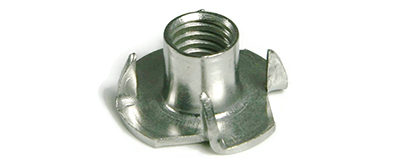
KYA M10 Tee Nuts are zinc-plated steel threaded inserts designed to create a reusable female thread in wood, plywood, particle board and other suitable wood-based panels. The four-prong design bites into the back side of the panel to help prevent the T-nut from rotating when a matching M10 bolt is installed or removed.
Also known as M10 T-nuts, 4-prong tee nuts, prong nuts or threaded wood insert nuts, these fasteners are commonly used in furniture assembly, climbing wall panels, speaker cabinets, woodworking fixtures and other applications that require a machine-thread connection in wood.
The zinc-plated steel construction provides better corrosion protection than untreated plain steel. For long-term outdoor, high-moisture or corrosive environments, buyers should confirm the required coating specification or whether a stainless steel fastener is more appropriate.
| Specification | Details |
|---|---|
| Product Name | M10 4-Prong Tee Nut |
| Fastener Type | T-Nut / Tee Nut / 4-Prong Wood Insert Nut |
| Thread Size | M10 |
| Thread Pitch | Confirm required pitch before ordering; M10 coarse-thread applications commonly use 1.5mm pitch |
| Material | Steel |
| Surface Finish | Zinc Plated / Zinc Coated |
| Prong Count | 4 Prongs |
| Installation Type | Press-In or Hammer-In from the Back Side of the Panel |
| Recommended Materials | Wood, Plywood, Particle Board and Suitable Wood-Based Panels |
| Main Applications | Furniture, Climbing Walls, Speaker Cabinets, Woodworking and Panel Assembly |
| Barrel Height | Confirm required dimension before ordering |
| Barrel Diameter | Confirm according to required installation hole |
| Flange Diameter | Confirm required specification before bulk production |
Important: M10 defines the nominal internal thread diameter but does not by itself define barrel height, flange diameter, barrel outside diameter or every other T-nut dimension. Buyers replacing an existing part should provide a drawing, sample or complete dimensional specification.

A T-nut creates a metal internal thread inside a wood-based panel. The cylindrical threaded barrel fits into a pre-drilled hole while the flange remains against the rear surface. When the four prongs are pressed or driven into the wood, they help resist rotation and movement during bolt installation.
A matching M10 bolt is then inserted from the opposite side of the panel and engages with the internal thread. This design allows the bolt to be removed and reinstalled without repeatedly cutting threads directly into the wood.
| Component | Function |
|---|---|
| M10 Internal Thread | Accepts a compatible M10 machine bolt or threaded fastener. |
| Threaded Barrel | Passes into the drilled hole and provides the internal metal thread. |
| Flange | Provides a broad bearing surface against the back of the wood panel. |
| Four Prongs | Bite into the wood to resist rotation and help retain the T-nut during bolt installation and removal. |
Correct installation is important because a T-nut that is installed crooked, insufficiently seated or in an oversized hole may rotate or pull away from the panel when the bolt is tightened or removed.
| Step | Installation Guidance |
|---|---|
| 1. Confirm Dimensions | Confirm the T-nut barrel outside diameter, barrel height, panel thickness and M10 bolt specification. |
| 2. Drill the Hole | Drill a clean hole sized for the actual barrel diameter. Do not select the drill size solely from the M10 thread designation. |
| 3. Insert from Rear | Insert the threaded barrel from the rear side of the wood or plywood panel. |
| 4. Seat the Prongs | Press or carefully hammer the flange so all four prongs enter the panel evenly. |
| 5. Check Alignment | Ensure the barrel is straight and the flange is seated correctly against the rear panel surface. |
| 6. Install M10 Bolt | Start the matching bolt carefully to avoid cross-threading and tighten according to the application requirements. |
The correct pilot-hole diameter depends on the actual T-nut barrel outside diameter. Because different M10 T-nut designs can use different barrel dimensions, confirm the KYA product drawing before specifying the drill size for production.

M10 4-prong T-nuts are used where a removable machine-bolt connection must be created in wood or wood-based panels. The four-prong configuration is especially useful where the back side of the panel can be accessed during initial installation.
| Application | Typical Use |
|---|---|
| Wooden Furniture | Creates a reusable machine-thread connection in furniture frames, panels, tables, beds and other suitable wood assemblies. |
| Climbing Wall Panels | Used behind suitable plywood panels to provide an M10 threaded anchor for compatible bolt-on climbing holds. |
| Plywood | Provides a metal thread where bolts must be repeatedly installed and removed from plywood panels. |
| Particle Board | Suitable for selected panel fastening applications when material density and load requirements are appropriate. |
| Speaker Cabinets | Provides threaded mounting points for loudspeaker boards, drivers and removable hardware. |
| Woodworking Fixtures | Used in jigs, fixtures, worktables and other projects requiring repeatable bolt connections. |

M10 T-nuts are commonly used behind plywood climbing-wall panels to create threaded mounting points for compatible bolt-on climbing holds. The T-nut is installed from the rear of the panel while the hold and M10 bolt are installed from the front.
Climbing-wall installations are load-bearing applications. Commercial or public climbing walls should use fasteners, panel construction and installation methods that meet the applicable climbing-wall design, testing and safety requirements. Do not assume that thread size alone determines load capacity.
Before ordering M10 T-nuts for a climbing-wall project, confirm the plywood thickness, barrel length, barrel outside diameter, hole diameter, bolt thread pitch, flange design, coating requirement and required mechanical or safety documentation.
The designation M10 identifies a nominal metric thread diameter of 10mm. It does not by itself confirm the thread pitch or every physical dimension of the T-nut.
| Selection Item | What to Confirm |
|---|---|
| Thread Diameter | M10 nominal metric thread. |
| Thread Pitch | M10 coarse threads commonly use 1.5mm pitch, but confirm the exact KYA specification and mating bolt before ordering. |
| Barrel Length | Select according to panel thickness, assembly geometry and required thread engagement. |
| Barrel Outside Diameter | Determines the required drilled-hole diameter. |
| Flange Diameter | Affects rear-panel bearing area and must match the application design. |
| Prong Geometry | Prong length and shape affect engagement with plywood or other wood materials. |
Many industrial 4-prong metric T-nuts are produced to or referenced against DIN 1624. Industry dimension tables commonly associate DIN 1624 M10 with a 1.5mm coarse thread pitch, but barrel height, flange dimensions and product variants can differ between manufacturers.
The current KYA source data identifies this product as an M10 four-prong zinc-plated steel T-nut but does not explicitly state DIN 1624 compliance. Buyers requiring DIN 1624 dimensions or certification should include that requirement in the quotation request and confirm the approved product drawing before production.
Zinc plating provides a protective metallic coating over the steel substrate and generally offers better corrosion resistance than untreated plain steel. However, standard zinc plating should not automatically be described as suitable for every permanent outdoor, wet or corrosive environment.
| Environment | Selection Guidance |
|---|---|
| Indoor Furniture | Zinc-plated steel is commonly used for normal dry indoor furniture and woodworking applications. |
| Indoor Climbing Walls | Can be suitable when the product dimensions, load requirements and installation specification are verified. |
| Occasional Moisture | Confirm coating thickness and expected service conditions. |
| Permanent Outdoor / Wet Use | Specify the required corrosion performance; stainless steel or another higher-corrosion-resistance solution may be preferable. |
Both T-nuts and threaded inserts create reusable machine threads in wood, but their installation methods and ideal applications differ.
| Feature | 4-Prong Tee Nut | Threaded Wood Insert |
|---|---|---|
| Installation | Pressed or hammered from the rear of the panel | Typically screwed or driven into a prepared hole |
| Rear Access | Normally required during initial installation | Often installed from the same side as the fastener |
| Retention Method | Flange and prongs engage the back of the panel | External insert threads or barbs engage the material |
| Typical Use | Furniture panels, climbing walls, speaker cabinets and plywood assemblies | Furniture, cabinetry, repair, CNC fixtures and applications with limited rear access |
KYA supplies T-nuts for furniture manufacturers, climbing wall builders, speaker manufacturers, woodworking businesses, hardware distributors, fastener importers and other professional buyers.
For bulk procurement, the thread designation alone is not sufficient. Buyers should provide the required thread pitch, barrel height, barrel outside diameter, flange diameter, prong dimensions, material, finish, packaging and expected application.
If the M10 T-nut is replacing an existing part, send KYA a technical drawing, physical sample or dimensional photograph. This reduces the risk of receiving an M10 threaded part with the wrong barrel or flange dimensions.
Request Wholesale M10 T-Nut Price Explore T-Nut Products
An M10 tee nut is a threaded insert used to create an M10 female thread in wood or other suitable panel materials. A four-prong version uses four pointed claws to help anchor the flange into the back of the panel.
Yes. T-nut and tee nut are commonly used names for the same general fastener. Four-prong T-nuts may also be called prong nuts, claw nuts or threaded wood insert nuts.
M10 identifies the nominal 10mm metric thread diameter. A 1.5mm pitch is commonly used for standard coarse M10 threads, but the current KYA source page does not explicitly state thread pitch. Confirm the required pitch before ordering.
Use an M10 bolt with the same thread pitch as the T-nut. Confirm both diameter and pitch before assembly to prevent cross-threading.
Drill-hole size should be selected from the actual outside diameter of the T-nut barrel, not simply from the M10 thread size. Different M10 T-nut designs can use different barrel diameters, so confirm the product drawing first.
Drill the correctly sized hole, insert the T-nut from the back of the panel, align it squarely and press or carefully hammer the flange until all four prongs are fully seated in the wood.
The prongs embed into the wood and help prevent the T-nut from rotating or moving while the bolt is tightened or removed.
Yes. Plywood is one of the common applications for four-prong T-nuts. Panel thickness, barrel dimensions, hole diameter and required load should be checked before production use.
They can be used in suitable particle-board applications, but retention depends on panel density, thickness, edge distance, installation quality and applied load. Testing the actual panel material is recommended for production applications.
Yes. M10 T-nuts are commonly used behind plywood climbing-wall panels to provide threaded anchor points for compatible M10 bolt-on holds. Commercial climbing-wall installations should follow the applicable structural and safety requirements.
Zinc plating provides better corrosion resistance than untreated steel, but suitability for permanent outdoor or wet use depends on coating specification and environmental exposure. Confirm the required corrosion performance before ordering.
DIN 1624 is commonly associated with four-prong metric T-nuts, but the current KYA product information does not explicitly state DIN 1624 compliance. Specify DIN 1624 if required and request dimensional confirmation before ordering.
Confirm thread pitch, barrel height, barrel outside diameter, flange diameter, flange thickness, prong dimensions, material, surface finish and required panel thickness.
M10 only identifies the nominal thread diameter. Different standards, manufacturers and application designs can use different barrel lengths, flange diameters, prong sizes and other dimensions.
Yes. KYA supplies T-nuts for furniture manufacturers, woodworking companies, climbing wall builders, speaker manufacturers, hardware distributors and other professional buyers.
Provide the thread diameter and pitch, barrel height, barrel outside diameter, flange diameter, material, zinc-plating requirement, quantity, application, destination country and packaging requirements. A drawing or sample is recommended when replacing an existing T-nut.
Looking for M10 zinc-plated 4-prong tee nuts? Send KYA Fasteners your required thread pitch, barrel height, flange diameter, barrel diameter, purchase quantity, application and destination country. If you are replacing an existing part, send a drawing or sample so the complete dimensions can be checked before quotation.