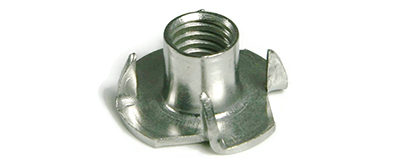
KYA M8 4-prong tee nuts provide a reusable internal threaded connection in plywood, solid wood, particleboard and other compatible wood-based components. The featured configuration combines an M8 internal thread, 10 mm barrel height, 24 mm flange and four retaining prongs with a zinc-plated steel construction.
The four-prong design is intended to embed into the back side of the workpiece and help resist rotation while an M8 bolt is tightened from the opposite side. Typical applications include furniture, bed frames, speaker cabinets, woodworking fixtures, CNC jigs and other M8 threaded wood assemblies.

M8 internal thread: designed for compatible M8 bolts and threaded fasteners.
10 mm barrel height: compact barrel configuration for installation into compatible wood panels and components.
24 mm flange: provides a broad rear bearing surface against the workpiece.
Four retaining prongs: designed to embed into wood and help resist rotation during assembly.
Zinc-plated steel: provides a protective zinc finish for general indoor and protected applications.
Rear installation: creates an internal machine-thread connection accessible from the opposite side of the panel.
Reusable bolted joint: allows compatible M8 bolts to be installed and removed without repeatedly threading directly into the wood.
| Parameter | Specification |
|---|---|
| Model | M8 |
| KYA Code | KYA-M8 |
| Fastener Type | 4-Prong Tee Nut / T-Nut |
| Internal Thread | M8 |
| Barrel Height | 10 mm |
| Flange Diameter | 24 mm |
| Prongs | 4 Long Prongs |
| Material | Steel |
| Finish | Zinc Plated |
| Installation | Rear-mounted into a correctly sized hole in compatible wood or wood-based panels |
In the product designation, M8 refers to the internal thread size, while 10 mm refers to the barrel height. Buyers should confirm the required thread pitch and mating bolt specification before placing production orders.

Correct dimensional matching is important when sourcing tee nuts for furniture production or industrial assembly. Check the internal thread, barrel height, flange diameter, workpiece thickness and installation-hole diameter before ordering.

Four prongs are formed around the flange and are driven into the wood during installation. Their purpose is to help hold the tee nut in position and resist rotation when the mating bolt is installed or removed.
Retention depends on the wood species, panel density, drilled-hole size, installation quality, flange seating and applied load. A four-prong tee nut should therefore not be assumed to be permanently spin-proof or pull-out-proof in every substrate.

The featured M8 tee nut is manufactured from steel with a zinc-plated finish. The zinc layer provides corrosion protection compared with unfinished bare steel and is commonly used for furniture, cabinetry, equipment and other indoor or protected assemblies.
Suitability for outdoor, wet, chemically aggressive or continuously exposed environments depends on the coating specification and service conditions. Buyers requiring a specific corrosion-resistance level should confirm the required material and finish before ordering.
A tee nut is normally installed from the rear side of the wooden component. A correctly sized hole is drilled through the workpiece, the barrel is inserted into the hole, and the flange is seated so that the four prongs enter the wood.
The mating M8 bolt is then inserted from the opposite side of the assembly. When the bolt is tightened, the tee nut provides a machine-threaded connection instead of relying on a screw thread cut directly into the wood.
Use a pilot hole matched to the actual barrel outside diameter. An oversized hole can reduce support around the barrel, while an undersized hole can damage the workpiece or interfere with installation.
The featured M8 configuration has a 10 mm barrel height. The barrel enters the drilled hole while the flange remains seated against the rear surface of the workpiece.
The current KYA product information references use with approximately 18–22 mm plywood. However, final panel suitability depends on the complete assembly, load, required thread engagement, bolt length and the material around the installation hole.

Furniture manufacturing: threaded connections in beds, tables, chairs, cabinets and other wood furniture assemblies.
Speaker cabinets: removable machine-screw connections in plywood and wood-based enclosures.
Woodworking fixtures: jigs, templates and adjustable shop fixtures requiring reusable M8 threads.
CNC router fixtures: selected fixture and jig assemblies where an M8 rear-mounted threaded insert is suitable.
Equipment panels: removable bolted connections in compatible wood and composite panels.
Playground and recreational equipment: selected wooden assemblies where the fastener specification and corrosion protection are appropriate.
Climbing-wall components: only where the climbing hold and bolt system specifically require an M8 internal thread.
Four-prong tee nuts are widely used to create a machine-threaded connection in furniture components without requiring a conventional hex nut to be held on the rear side during final assembly.
Typical applications include bed frames, upholstered furniture, cabinets, tables and removable wooden components. For production assemblies, confirm the required bolt grade, thread specification, panel material and joint load before selecting the tee nut.
Tee nuts can provide a reusable threaded connection for speaker drivers, access panels and other removable components in suitable plywood or wood-based enclosures.
The correct M8 fastener should be selected according to the mounting-hole pattern, panel thickness, bolt specification and required clamping force.
An M8 tee nut can only be used with a climbing hold when the hold's mounting hardware is designed for an M8 bolt and matching M8 internal thread.
Climbing-wall hardware is produced in several thread systems, including imperial and larger metric formats. For this reason, M8 should not be treated as universally interchangeable with other climbing-wall tee nuts.
Before purchasing M8 tee nuts for a climbing-wall project, verify the climbing hold bolt diameter, thread specification, panel construction, mounting-hole size and load requirements.

M8, M10 and 3/8" tee nuts use different thread dimensions and should not be treated as interchangeable simply because the products look similar.
| Thread System | Buyer Check |
|---|---|
| M8 | Use only with the matching M8 bolt and confirmed thread specification. |
| M10 | Larger metric thread system; not interchangeable with M8. |
| 3/8" | Imperial thread system; verify the exact threads-per-inch specification before matching the bolt. |
In addition to the featured M8 tee nut, KYA lists other metric and imperial tee nut sizes for different assembly requirements.
| Thread | Page-Listed Barrel Height | Page-Listed Flange Diameter | Configuration |
|---|---|---|---|
| M8 | 10 mm | 24 mm | 4 long prongs, zinc-plated steel |
| M6 | 8–10 mm | 19–21 mm | 4 prongs, zinc plated |
| M10 | 12–16 mm | 28–30 mm | 4 prongs; finish depends on configuration |
| 5/16" / 3/8" | 8–16 mm | 21–30 mm | 4 prongs, zinc plated |
Tee nuts can also be produced with different flange-retention arrangements for specific assembly requirements. The appropriate design depends on panel material, production method and resistance to rotation or displacement.

When correctly installed, the flange seats against the rear face of the wood while the threaded barrel extends into the drilled hole. The bolt is installed from the opposite side to create the clamped assembly.

| Selection Item | What to Check |
|---|---|
| Thread | Confirm that the mating bolt uses the required M8 thread specification. |
| Barrel Height | Confirm that the 10 mm barrel suits the panel and joint design. |
| Flange Diameter | Verify that the 24 mm flange has sufficient rear-face clearance. |
| Installation Hole | Match the drilled hole to the actual barrel outside diameter. |
| Panel Material | Confirm that the wood, plywood or composite panel provides suitable support for the prongs. |
| Finish | Match zinc-plated steel to the environmental and corrosion requirements of the assembly. |
| Joint Load | Select the fastener and installation method according to the actual tensile, shear and rotational loads. |
For an accurate quotation, provide the required quantity, thread specification, barrel height, flange diameter, application, panel material, panel thickness and destination market.
The current KYA product information lists a minimum order quantity of 5,000 pieces and indicates that sample quantities can be arranged. Confirm the current MOQ, sample quantity, packing and freight terms when requesting pricing.
For this KYA product, M8 identifies the internal thread size and 10 mm identifies the barrel height. Confirm the mating bolt thread specification before ordering.
The current KYA specification lists a 24 mm flange diameter.
The featured KYA M8 tee nut uses four long retaining prongs designed to embed into compatible wood materials.
The featured product is listed as zinc-plated steel.
Typical uses include furniture, bed frames, speaker cabinets, woodworking fixtures, CNC jigs and other wood assemblies requiring a reusable M8 threaded connection.
Yes, when the plywood thickness, drilled-hole diameter and joint design are suitable for the tee nut. The current KYA page references approximately 18–22 mm plywood for the featured 10 mm barrel configuration.
The four prongs are designed to resist rotation by embedding into the wood. Actual retention depends on the workpiece material, hole size, installation quality and applied torque.
Drill a hole matched to the barrel outside diameter, insert the tee nut from the rear of the workpiece and seat the flange so the four prongs embed evenly into the wood. Avoid striking directly on or damaging the internal thread.
The bolt must match the tee nut's complete thread specification. Confirm thread diameter and pitch rather than relying only on the M8 designation.
Only when the climbing hold is designed for an M8 bolt system. Climbing hardware is available in different metric and imperial thread formats, so M8 should not be treated as a universal climbing-wall standard.
No. M8 and M10 use different thread diameters and require matching bolts and climbing-hold hardware.
No. M8 is a metric thread designation, while 3/8" is an imperial diameter. Use the thread system specified for the mating bolt and application.
Suitability depends on the zinc coating specification and exposure conditions. For continuously wet, coastal or corrosive environments, confirm the required corrosion-resistant material or finish before ordering.
The current KYA product information lists additional configurations including M6, M10, 5/16" and 3/8" tee nuts.
The current KYA product information lists a minimum order quantity of 5,000 pieces. Confirm the current MOQ and packing configuration when requesting a quotation.
The current product information indicates that sample quantities can be arranged. Confirm the available sample quantity, packing and freight terms with KYA.
Provide the required quantity, thread specification, barrel height, flange diameter, panel material, panel thickness, intended application and destination market.
KYA supplies M8 4-prong zinc-plated steel tee nuts for furniture manufacturers, woodworking businesses, speaker cabinet manufacturers, hardware distributors and professional assembly applications. Send your required quantity, panel specification and mating bolt requirements to confirm the appropriate tee nut configuration.