Views: 0 Author: Site Editor Publish Time: 2026-08-16 Origin: Site
A coil nail is not defined by length alone. To select a compatible coil nail, match all seven specifications: shank diameter, nail length, head diameter, head style, shank type, collation type and collation angle.
For example, a “2-inch coil nail” may be a thin siding nail, a heavier framing nail or a pallet nail. The same length does not mean the nails will fit the same coil nailer.
Application | Common Shank Diameter | Typical Length | Typical Head Diameter | Common Collation | Common Shank |
|---|---|---|---|---|---|
Asphalt roofing | .120" / 3.05 mm | 3/4"–1-3/4" / 19–45 mm | About .375"–.413" / 9.5–10.5 mm | 15° or manufacturer-rated wire coil | Smooth or ring |
Siding | .083"–.099" / 2.1–2.5 mm | 1-1/4"–2-1/2" / 32–64 mm | About .197"–.236" / 5.0–6.0 mm | 15° wire or plastic sheet | Ring or smooth |
Fencing and decking | .090"–.113" / 2.3–2.87 mm | 1-1/2"–3" / 38–76 mm | About .217"–.275" / 5.5–7.0 mm | Usually 15° wire coil | Ring or screw |
Framing and sheathing | .099"–.148" / 2.5–3.76 mm | 2"–3-1/2" / 50–90 mm | About .256"–.315" / 6.5–8.0 mm | Usually 15° flat wire coil | Smooth, ring or screw |
Pallets and crates | .082"–.148" / 2.1–3.76 mm | 1"–4" / 25–100 mm | About .197"–.315" / 5.0–8.0 mm | 15° flat wire coil | Screw, ring or smooth |
These are common industry ranges, not universal approvals. Always follow the fastener range in the nailer manual and the fastening requirements for the material or building system.
Coil nail dimensions are normally written as:
Shank diameter × nail length
For example:
2.5 × 50 mm means a 2.5 mm diameter and 50 mm long nail.
.099" × 2" describes approximately the same nominal size.
3.05 × 32 mm is approximately .120" × 1-1/4", a common roofing nail size.
Length is measured from the underside of the head to the nail point. Head diameter is measured across the widest part of the head. The collation angle describes how the fasteners are arranged and fed in the coil; it does not mean the nail enters the workpiece at that angle.
The actual shank diameter is more reliable than an approximate nail gauge. When ordering for a pneumatic tool, use the diameter shown in the tool manual.
Imperial Diameter | Metric Equivalent | Common Application Class |
|---|---|---|
.080" | 2.03 mm | Light siding and packaging |
.082" | 2.08 mm | Light pallet and siding work |
.083" | 2.11 mm | Siding and light-duty coil nailers |
.086" | 2.18 mm | Plastic-sheet siding coils |
.090" | 2.29 mm | Siding, fencing and sheathing |
.092" | 2.34 mm | Siding, fencing and light pallets |
.099" | 2.51 mm | Siding, pallets and light framing |
.105" | 2.67 mm | Pallets and general construction |
.113" | 2.87 mm | Framing, sheathing and heavy pallets |
.120" | 3.05 mm | Roofing or framing, depending on head and collation |
.122" | 3.10 mm | Framing and heavy-duty applications |
.131" | 3.33 mm | Framing, decking and heavy pallets |
.148" | 3.76 mm | Heavy framing and industrial pallets |
.150" | 3.81 mm | Specialty heavy-duty fastening |
A .120-inch diameter does not automatically identify a roofing nail. A .120-inch framing nail normally has a smaller head and a different length range than a .120-inch roofing nail.
Imperial Length | Exact Metric Conversion | Common Nominal Metric Size |
|---|---|---|
3/4" | 19.05 mm | 19 mm |
7/8" | 22.23 mm | 22 mm |
1" | 25.40 mm | 25 mm |
1-1/4" | 31.75 mm | 32 mm |
1-1/2" | 38.10 mm | 38 mm |
1-3/4" | 44.45 mm | 45 mm |
2" | 50.80 mm | 50 or 51 mm |
2-1/4" | 57.15 mm | 57 mm |
2-1/2" | 63.50 mm | 64 or 65 mm |
2-3/4" | 69.85 mm | 70 mm |
3" | 76.20 mm | 75 or 76 mm |
3-1/4" | 82.55 mm | 83 mm |
3-1/2" | 88.90 mm | 90 mm |
4" | 101.60 mm | 100 mm |
5" | 127.00 mm | 125 or 130 mm |
Nominal metric sizes are often rounded for manufacturing and product naming. Confirm the permitted tolerance before treating two rounded sizes as identical.
Head diameter affects both holding area and tool compatibility. A head that is too large may not pass through the nose guide, while a head that is too small may not provide the required bearing area.
Head Type | Typical Use | Selection Consideration |
|---|---|---|
Wide round roofing head | Asphalt shingles, roofing felt and insulation board | Provides a larger bearing surface; must fit a roofing nailer |
Full round flat head | Framing, pallets, fencing and sheathing | Common general-purpose coil nail head |
Checkered head | Framing, pallets and industrial fastening | Textured surface can improve driver contact and identification |
Painted head | Siding, fencing and visible fastening | Color can match the finished material; dimensions must still match the nailer |
Duplex head | Concrete forms, scaffolding and temporary bracing | Designed for later removal and requires a compatible duplex coil nailer |
Typical head ranges differ by tool class:
Roofing coil nails often use heads around .375"–.413" (9.5–10.5 mm).
Siding coil nails commonly use heads around .197"–.236" (5.0–6.0 mm).
Framing coil nails commonly use heads around .256"–.315" (6.5–8.0 mm).
Head requirements may also be controlled by a building code, siding manufacturer, roofing system or engineering specification.
Smooth shank nails drive quickly and require less driving force than most deformed-shank nails. They are commonly used for roofing, general framing, sheathing, temporary construction and applications where extreme withdrawal resistance is not required.
Their lower surface friction can make them less suitable for assemblies exposed to vibration, repeated moisture movement or strong withdrawal loads.
Ring shank, also called annular ring shank, nails have a series of rings that engage the wood fibers. They are widely used for siding, decking, fencing, pallets and sheathing where resistance to nail back-out is important.
Ring shank nails can require more driving energy than a smooth nail of the same diameter. Confirm that the nailer is rated for the selected diameter, length and substrate.
Screw or helical shank nails rotate slightly as they enter the wood. They are often selected for hardwood pallets, crates, decking and industrial wood packaging.
They provide strong resistance to movement but may increase driving resistance and tool wear. Production users should conduct a driving and withdrawal test with the actual wood species before placing a bulk order.
Requirement | Recommended Starting Point |
|---|---|
Fast driving and general construction | Smooth shank |
Higher withdrawal resistance in softwood | Ring shank |
Pallets, crates or selected hardwood applications | Screw shank |
Roofing shingles | Smooth or code-approved ring shank |
Siding exposed to movement and wind | Ring shank, subject to siding specifications |
Temporary fastening | Smooth or compatible duplex nail |
The correct shank is determined by the joint design, substrate, required withdrawal resistance and applicable installation specification—not by holding-power claims alone.
Collation is the system that holds individual nails together and controls how they feed through the nailer.
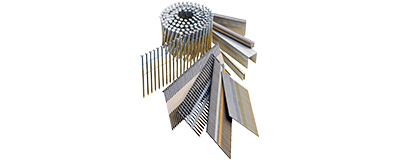
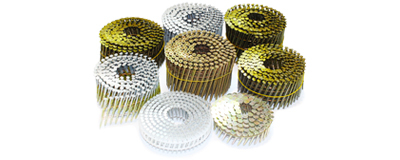
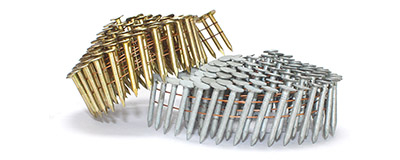
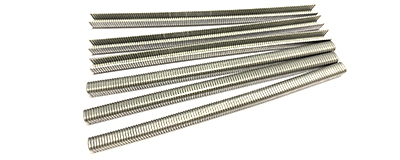
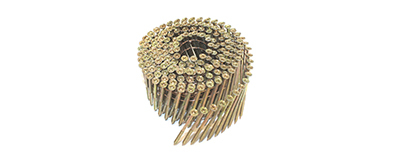
Wire-collated nails are joined by thin metal wires welded across the shanks. This format is common in roofing, framing, pallet, fencing and industrial coil nailers.
Advantages include:
High coil capacity.
Stable feeding in high-volume production.
Availability in a wide range of diameters and lengths.
Smooth, ring and screw shank options.
Check the required wire position, coil pitch, flat or conical coil shape and head arrangement. Two wire coils with the same angle can still have different feed geometry.
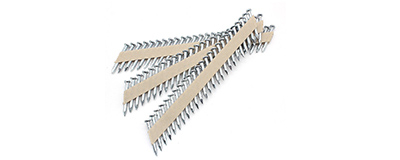
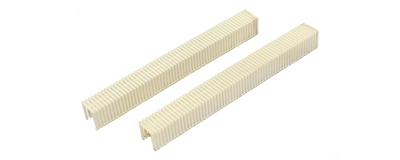
Plastic-sheet nails are held in a formed plastic carrier. They are commonly used in selected siding, fencing, decking and specialty tools.
Potential benefits include:
No metal collation wire across the work surface.
Suitable for tools designed to accept plastic-sheet coils.
Availability in painted-head and exterior siding configurations.
Carrier fragments and ejection behavior vary by tool and fastener design. Wear eye protection and follow the nailer manufacturer’s loading and safety instructions.
A flat coil has nail heads arranged at approximately the same level. A conical coil has an offset or stepped head arrangement that creates a tapered coil.
The magazine, feed pawl and nose are designed for specific coil geometry. Do not assume that a flat coil and a conical coil are interchangeable because their diameter, length and angle match.
Some plastic-sheet, trim and specialty coil nails are marketed as 0°. They require tools designed for that carrier and alignment. A 0° plastic coil is not a substitute for a 15° or 16° wire coil.
The short answer is: 15-degree and 16-degree coil nails are not automatically interchangeable.
The number describes the nominal collation or magazine geometry. In the market, some wire coils are labeled 15°, while certain tool specifications use 16° or 16° ±1°. This can create apparent conflicts even when products look almost identical.
Factor | 15° Coil Nails | 16° Coil Nails |
|---|---|---|
Common collation | Wire weld or plastic sheet | Usually wire weld |
Common applications | Roofing, siding, fencing, framing and pallets | Roofing and selected wire-coil tools |
Market labeling | Widely sold as 15° coil nails | Used by certain manufacturers and tool revisions |
Guaranteed interchangeability | No | No |
Correct selection method | Match the exact tool manual | Match the exact tool manual |
A one-degree difference may fall within the stated tolerance of some nailers, but angle alone does not prove compatibility. You must also compare:
Wire or plastic collation.
Nail length range.
Shank diameter range.
Head diameter and head arrangement.
Flat or conical coil geometry.
Coil pitch and welding-wire position.
Magazine and coil capacity.
Manufacturer-approved fastener type.
For example, one Metabo HPT specification card lists the NV45AB2 roofing nailer as 16° ±1° wire, while many roofing coils in the wider market are sold under the 15° category. The NV65AH2 has also appeared with different angle descriptions across product pages and tool cards. The safe reference is the manual supplied with the exact tool version and market.
Only when the tool manufacturer or the manual confirms that the specific fastener geometry is accepted. Do not load a 16° coil into a 15° tool based solely on appearance or the one-degree difference.
An incompatible coil can cause:
Feed-pawl misalignment.
Skipped nails or double feeds.
Nail-head interference.
Cut heads.
Nose jams.
Damage to the driver, feed system or magazine.
The following chart is a purchasing reference, not a substitute for the manual supplied with the tool.
Brand and Model | Tool Class | Collation / Angle | Accepted Length | Shank Diameter |
|---|---|---|---|---|
KYA CN55 | Siding, fencing, pallets | 15° flat wire coil | 1-1/4"–2-1/4" / 32–57 mm | .083"–.099" / 2.1–2.5 mm |
KYA CN80 | Framing, pallets, sheathing | 15° flat wire coil | 2"–3-1/4" / 50–83 mm | .099"–.131" / 2.5–3.3 mm |
KYA CN100 | Heavy pallets, crates, framing | 15° flat wire coil | 65–100 mm / about 2-9/16"–3-15/16" | 2.5–3.3 mm / about .099"–.131" |
MAX CN565S3 | Siding and sheathing | 15° wire or plastic sheet | 1-1/4"–2-1/2" / 32–64 mm | .083"–.099" / 2.1–2.5 mm |
MAX CN890F2 | Framing and heavy construction | 15° wire coil | 2"–3-1/2" / 50–90 mm | .099"–.131" / 2.5–3.3 mm |
Makita AN613 | Siding | 15° wire or plastic sheet | 1-1/2"–2-1/2" / 38–65 mm | .090"–.099" / 2.3–2.5 mm |
SENCO RoofPro 445XP | Roofing | 15° wire roofing coil | 3/4"–1-3/4" / 19–45 mm | .120" / 3.05 mm |
SENCO SN71P1 | Siding and fencing | 15° wire or plastic carrier | 1-1/4"–2-1/2" / 32–64 mm | .082"–.092" / 2.1–2.34 mm |
Metabo HPT NV45AB2 | Roofing | 16° ±1° wire, according to tool card | 7/8"–1-3/4" / 22–45 mm | .120" / 3.05 mm |
Metabo HPT NV65AH2 | Siding | Current page: 15° wire/plastic; some tool cards list 16° ±1° wire and 15° ±1° plastic | 1-1/2"–2-1/2" / 38–64 mm | .090"–.099" / 2.3–2.5 mm |
Manufacturer specifications used for verification include KYA CN55, KYA CN80, KYA CN100, MAX CN565S3, Makita AN613, SENCO RoofPro 445XP and Metabo HPT NV65AH2. Specifications can change by region or product revision.
Asphalt roofing nails are commonly:
.120" / 3.05 mm in shank diameter.
3/4"–1-3/4" / 19–45 mm long.
Made with a wide round head.
Wire collated for a compatible roofing nailer.
Smooth or ring shank.
Electro-galvanized, hot-dip galvanized or stainless steel.
Select the length according to the roofing system, deck thickness and applicable installation requirements. Roofing nails, siding nails and framing nails are not interchangeable tool classes even when some dimensions overlap.
Siding nails commonly use a thinner shank and smaller head than roofing nails. Typical ranges are .083"–.099" in diameter and 1-1/4"–2-1/2" in length.
For fiber cement, wood siding or engineered siding, confirm:
The siding manufacturer’s approved nail diameter and head size.
Required penetration into framing.
Whether blind nailing or face nailing is specified.
Corrosion-resistance requirements.
Whether the nailer accepts wire, plastic sheet or both.
Avoid overdriving the nail head, which can damage the siding or restrict required material movement.
Ring shank coil nails are commonly selected for fencing and decking because outdoor wood expands, contracts and experiences vibration.
Use hot-dip galvanized or an appropriate stainless steel grade when required by the environment, wood treatment and project specification. Confirm that the finish is compatible with pressure-treated lumber.
Framing coil nails commonly range from .099" to .148" in diameter and from 2" to 3-1/2" in length. Full round heads and 15° flat wire collation are common.
Structural fastener selection must follow the approved construction documents, local code and tool specifications. Do not replace a specified nail with a thinner nail merely because both fit the magazine.
Pallet manufacturers use a wide range of coil nails because softwood, hardwood, recycled boards and export packaging have different fastening requirements.
Common starting points include:
Ring shank for withdrawal resistance in softer wood.
Screw shank for selected hardwood pallets and crates.
Smooth shank for high-speed general assembly.
Painted or adhesive-coated nails where specified.
Flat wire coils for high-capacity production nailers.
Before a production order, test the nail in the actual wood species and measure drive quality, splitting, head seating and withdrawal performance.
Use this basic calculation:
Required nail length = thickness of the attached material + required penetration into the base material
The required penetration is not universal. It depends on the connection, material, manufacturer instructions and applicable code.
Also check:
Whether the point may protrude through the back of the assembly.
Whether a longer nail could split thin or dry material.
Whether the tool has enough power for the selected diameter and substrate.
Whether the magazine and nail support are set for that length.
Whether the active ring or screw portion reaches the base material.
Always test the final combination before bulk purchasing.
Finish or Material | Typical Environment | Important Limitation |
|---|---|---|
Bright steel | Dry interior work, pallets and temporary construction | Little or no corrosion protection |
Electro-galvanized | Interior work and limited moisture exposure | Usually less corrosion-resistant than HDG or stainless |
Hot-dip galvanized | Exterior construction and many treated-wood applications | Verify coating weight and compatibility with the wood treatment |
Mechanical galvanized | Exterior and industrial applications where specified | Performance depends on coating thickness and specification |
304 stainless steel | Exterior, humid and many coastal applications | Confirm compatibility with the material and exposure |
316 stainless steel | Marine, coastal and high-chloride environments | Higher cost but stronger chloride-corrosion resistance |
Painted or coated | Pallets, identification or visible siding | Color or resin coating does not automatically replace corrosion protection |
Finish determines environmental suitability, but it does not correct a dimensional or collation mismatch.
Before requesting a quote, record the following information:
Exact nailer brand and model.
Tool application: roofing, siding, framing, fencing or pallets.
Collation type: wire weld or plastic sheet.
Collation angle: 0°, 15°, 16° or the stated tolerance.
Shank diameter and length.
Head diameter and head style.
Shank type, material, finish, coil count and packaging requirement.
A complete purchase description could read:
15° flat wire coil nail, .099" × 2" / 2.5 × 50 mm, 6.0 mm full round head, ring shank, diamond point, hot-dip galvanized, 300 nails per coil, for KYA CN80.
This is much safer than ordering “2-inch galvanized coil nails.”
Problem | Possible Fastener Cause | What to Check |
|---|---|---|
Coil will not sit correctly in the magazine | Wrong coil form, carrier or magazine setting | Flat/conical format, coil diameter and nail support height |
Nails jam at the nose | Wrong head, diameter, angle or damaged welds | Full dimensional specification and coil quality |
Nailer skips nails | Incorrect pitch, wire position or feed alignment | Feed pawl engagement and manufacturer-approved collation |
Nail heads are cut off | Head or collation misalignment | Head diameter, coil angle, driver condition and air pressure |
Nails stand proud | Nail too large, low pressure or hard substrate | Diameter, length, pressure, depth setting and tool power |
Nails overdrive | Excessive pressure or incorrect depth setting | Reduce pressure within the approved range and adjust depth |
Frequent double feeds | Damaged coil or feed-system problem | Coil pitch, feed pawl, trigger mode and tool maintenance |
Nails back out after installation | Inadequate penetration or unsuitable shank | Joint design, length, shank type and substrate |
Disconnect the air supply before inspecting, clearing or adjusting a pneumatic nailer.
There is no single most common size across every application. Roofing commonly uses .120" diameter nails from 3/4" to 1-3/4". Siding commonly uses .083"–.099" nails from 1-1/4" to 2-1/2". Framing and pallets commonly use .099"–.131" or larger nails from 2" to 3-1/2".
It describes the nominal collation geometry used to arrange and feed the nails in the coil. It does not describe the angle at which the nail enters the material.
Not automatically. Some tools have an angle tolerance that may cover both labels, but compatibility also depends on collation material, coil shape, pitch, head size, diameter and length. Use the exact tool manual or obtain manufacturer confirmation.
Generally no. Roofing nails usually have a much wider head and a .120" shank, while siding nailers often accept thinner nails with smaller heads. Use the fastener class specified for the tool.
Only in nailers specifically designed to accept both collation types. A tool that accepts wire coils may not have the magazine, feed pawl or discharge path required for plastic-sheet coils.
Both refer to nail thickness, but gauge designations can vary by nail category. The measured diameter in inches or millimeters is the safer value for nailer compatibility.
Ring and screw shanks generally provide more withdrawal resistance than a comparable smooth shank, but performance depends on wood species, penetration, diameter and fastener design. Test the actual joint rather than choosing by shank name alone.
Use galvanized nails when their coating is approved for the expected exposure and material. Use stainless steel when the project requires higher corrosion resistance, especially in coastal, marine or high-chloride environments.
Common hand-held coil nailers hold approximately 120–400 nails, depending on the nail size and tool. Industrial pallet systems may use jumbo coils containing thousands of nails. Coil capacity does not by itself determine compatibility.
Match the model manual against the nail’s collation type, angle, length, shank diameter, head diameter, coil geometry and capacity. For bulk orders, test a sample coil in the actual tool and material.
KYA Fasteners supplies wire-collated and plastic-sheet coil nails in metric and imperial sizes for roofing, siding, fencing, framing, pallets and crates.
Explore:
Send KYA your nailer model, required diameter, length, head, shank, finish and collation type for a compatibility check, sample coil or bulk quotation.