Views: 34 Author: KYA Fasteners Publish Time: 2023-05-14 Origin: Site
Galvanized coil nails are carbon-steel nails protected by zinc and collated in coils for high-production pneumatic nailers. The zinc acts as a sacrificial coating: it corrodes before the steel underneath. However, the word galvanized alone does not tell a buyer how much protection a nail has.
For dry indoor work, electro-galvanized (EG) coil nails are usually the economical choice. For exterior construction, frequent condensation, or preservative-treated wood, specify hot-dip galvanized (HDG) nails with a measurable coating requirement—typically ASTM A153/A153M Class D when the finished nail is galvanized after forming. For oceanfront, salt-splash, permanent-wet, or highly corrosive treated-wood applications, Type 304/305 or Type 316 stainless steel may be the safer specification.
| Project Condition | Recommended Material or Finish | Typical Coating Specification | Buyer’s Main Check |
|---|---|---|---|
| Dry indoor pallets, crates and furniture frames | Bright or regular EG | EG 3–5 μm when basic rust protection is required | Dimensions, collation and feeding consistency |
| Indoor humidity or occasional condensation | Heavy EG | 8–12 μm, with passivation or topcoat stated | Coating thickness plus a defined salt-spray report |
| Exterior, above ground and non-coastal | HDG | ASTM A153/A153M Class D for post-formed HDG: 43 μm minimum average | Process, thickness certificate and coating coverage |
| ACQ, CA or other preservative-treated wood | HDG Class D minimum or stainless steel | Match the wood treater, connector manufacturer and local code | Wood chemistry, retention level and wet-service exposure |
| Coastal salt air, salt splash, docks or severe chloride exposure | Type 316 stainless steel preferred | Material-grade certificate rather than zinc thickness | Do not assume HDG is a lifetime marine solution |
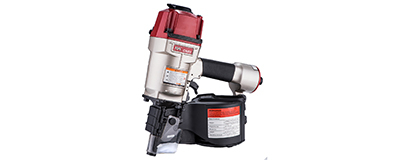
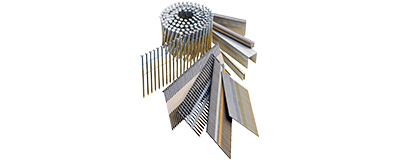
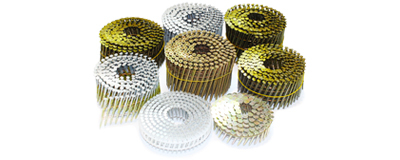
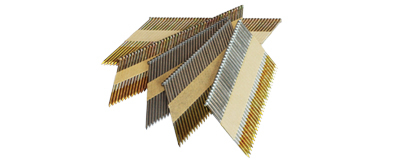
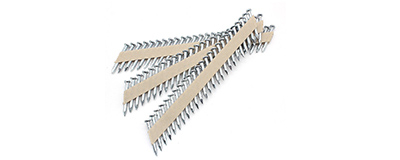
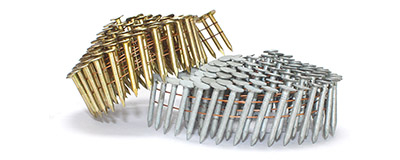
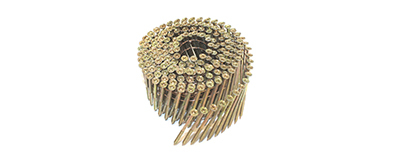
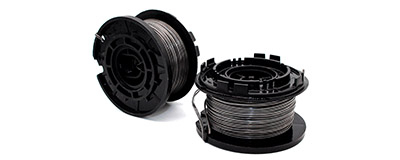
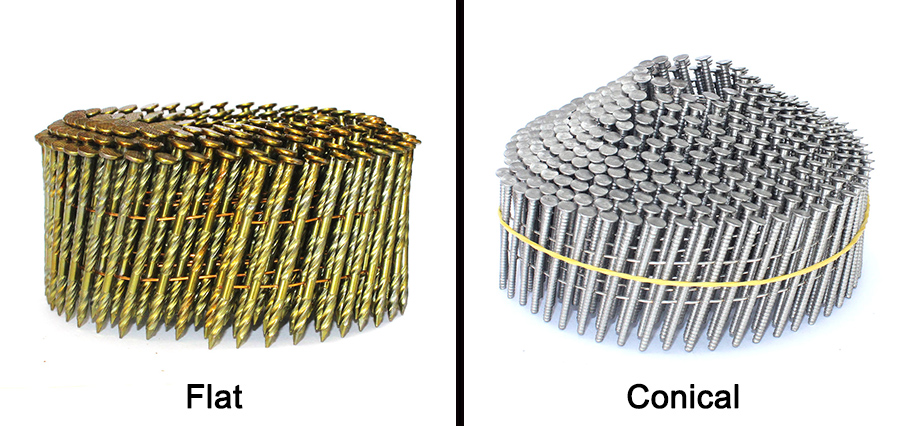
Coil nails are nails joined by welded wire or a plastic sheet and wound into a flat or conical coil. A coil magazine holds far more fasteners than a strip nailer, so operators reload less often. This makes coil nails common in pallet and crate production, fencing, siding, sheathing and roofing.
The nail body, shank profile and collation determine driving and holding performance. Galvanizing has a different job: it slows corrosion. Zinc protects the steel in two ways. First, it creates a barrier between steel and the environment. Second, zinc provides sacrificial protection to small exposed areas when the coating is scratched. As zinc is consumed, protection decreases; therefore, coating thickness and uniformity matter.
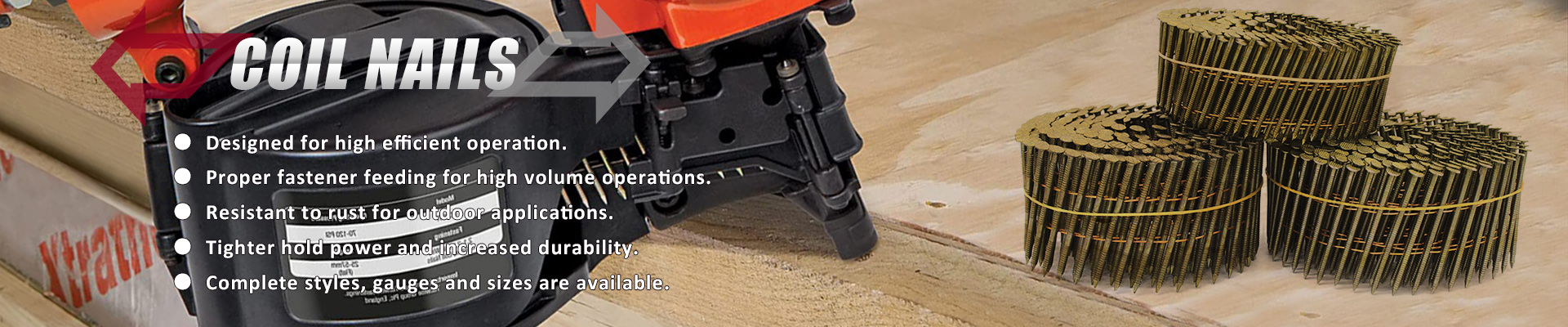
Electro-galvanizing deposits zinc onto steel using an electric current. It produces a smooth, bright and dimensionally controlled finish that usually feeds cleanly through a pneumatic tool. Regular commercial EG coil nails commonly carry about 3–5 μm of zinc, while heavier EG specifications are often in the 8–12 μm range.
EG is normally the lowest-cost galvanized option, but a thin layer can be consumed quickly by condensation, rain, salts or preservatives in treated lumber. It is best used in dry interiors, protected packaging, furniture frames and short-life applications. Do not approve a product for outdoor work simply because the carton says “galvanized.”
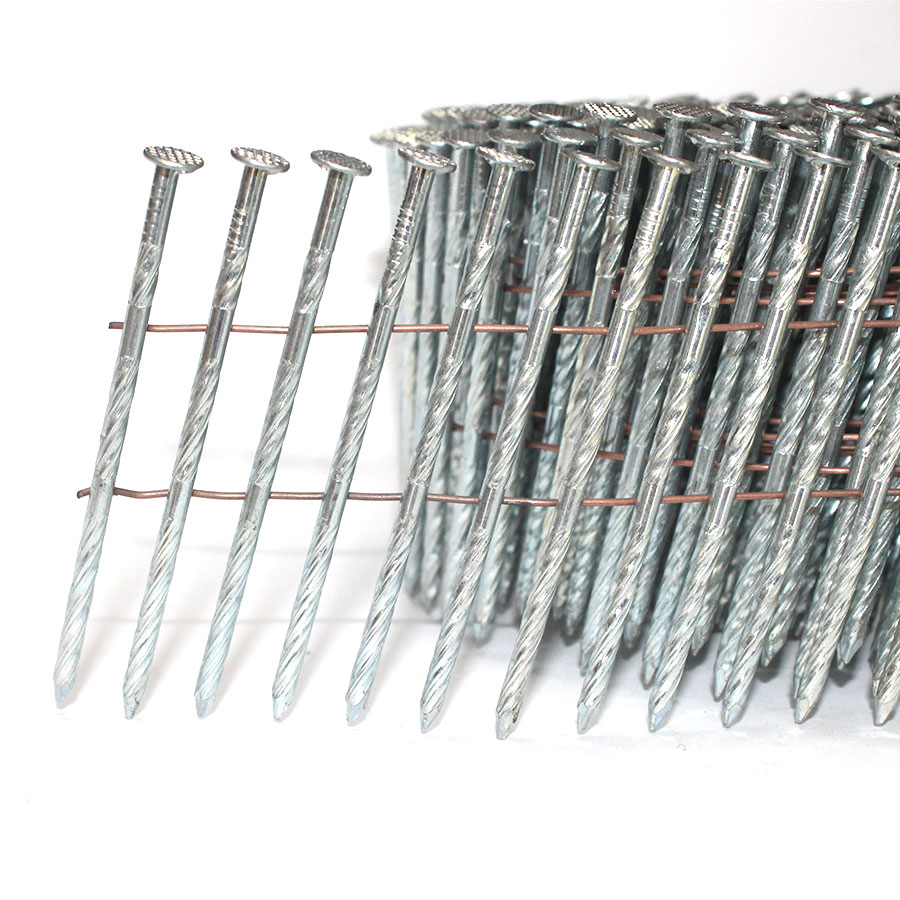
In hot-dip galvanizing, zinc is applied at high temperature and forms zinc-iron alloy layers bonded to the steel. The finish is thicker and more textured than EG and normally resists abrasion and long-term weathering better.
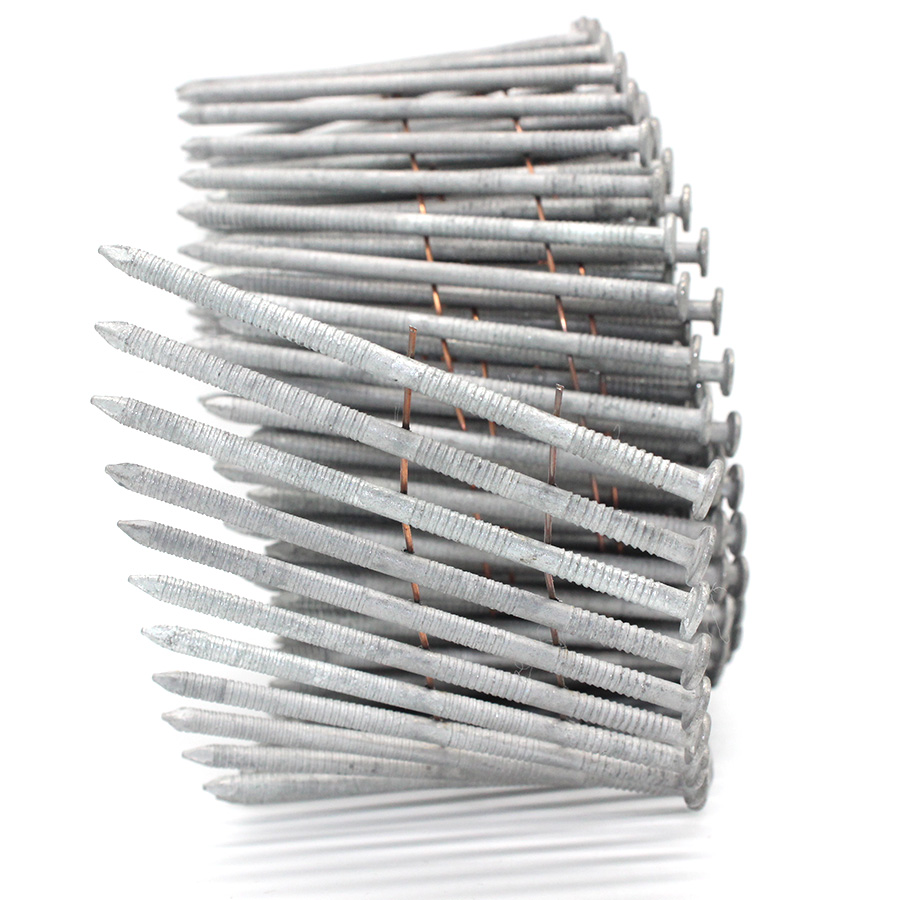
There are two product routes that buyers should distinguish:
Made from galvanized wire: The starting wire is zinc coated before the nail is headed, pointed and collated. The order should state the required wire-coating class because forming and cutting can affect coverage at the head and point.
Galvanized after forming: The finished nail is coated from head to point. For common nails and similar fasteners 3/8 in. (9.52 mm) or less in diameter, ASTM A153/A153M Class D requires a minimum average zinc coating of 1.00 oz/ft², equivalent to approximately 43 μm, and a minimum of approximately 36 μm on an individual specimen.
ASTM F1667/F1667M points buyers to ASTM A641/A641M for nails made from galvanized wire and to ASTM A153/A153M Class D when the heavier post-formed HDG coating is specified for exterior use or treated wood. Consequently, “HDG” is still incomplete as a purchase description—the process, class and required certificate should be stated.
| Factor | Regular EG | Heavy EG | Post-Formed HDG Class D |
|---|---|---|---|
| Typical or required zinc thickness | Approximately 3–5 μm typical | Approximately 8–12 μm specified | 43 μm minimum average; 36 μm minimum individual |
| Surface | Smooth and bright | Smooth and bright | Matte and more textured |
| Corrosion protection | Basic | Moderate, mainly for protected service | High for many exterior and wet-service applications |
| Best-fit environment | Dry indoor | Indoor humidity or occasional condensation | Exterior non-marine, subject to project requirements |
| Relative purchase-price index* | 1.00 | 1.05–1.15 | 1.15–1.35 |
*Budgetary comparison for the same nail geometry and order quantity. Zinc price, packaging, certification, location and order size can change the actual quotation.
Coating thickness is a more useful purchasing control than the finish name alone. For EG, write a numerical minimum such as 5, 8 or 12 μm and state whether it applies to the local minimum or the batch average. For post-formed HDG nails, ASTM A153/A153M Class D provides both coating-mass and thickness criteria.
A reliable incoming-inspection plan should include:
The galvanizing route: zinc plated after forming, made from galvanized wire or hot-dip galvanized after forming.
The coating standard and class, not only “EG” or “HDG.”
Minimum average and minimum individual thickness.
Measurement method, sample size and locations on the head and shank.
Coverage requirements for the head, shank and point.
Lot number and a certificate that links test results to the shipped batch.
Appearance is not proof. A bright nail may carry a thin electroplated layer, and a dull nail is not automatically compliant with ASTM A153. Confirm compliance with calibrated coating-thickness measurements or coating-mass testing.
ASTM B117 and ISO 9227 define how to operate a salt-spray cabinet; neither standard assigns a universal number of passing hours to a galvanized coil nail. The product specification must define the exposure time, sample preparation and pass/fail criterion.
For example, “500 hours salt spray” is incomplete. A buyer should write: 500 hours neutral salt spray in accordance with ASTM B117, no red rust on the head or shank, excluding the intentionally cut point if agreed, tested on finished production nails, with photographs and a third-party or approved-laboratory report.
| Finish | Common Purchasing Benchmark | Suggested Use | How to Treat the Number |
|---|---|---|---|
| Regular EG, 3–5 μm | 24 hours to red rust minimum | Dry indoor or basic transit protection | A modest quality-control screen, not outdoor approval |
| Heavy EG, 8–12 μm | 48–96 hours to red rust, as agreed | Protected humid interiors | Passivation and sealer can change the result; name them |
| HDG, 43 μm average minimum | 300–500 hours to red rust is a common project screen | General exterior and wet service | ASTM A153 controls the zinc coating, not salt-spray hours |
| Premium tested coating | 1,000 hours when specifically required and certified | Projects requiring a high laboratory benchmark | Do not infer 1,000 hours from “HDG”; require the test report |
Red rust indicates corrosion of the steel substrate; white corrosion is a zinc corrosion product. State which endpoint is limited and how much affected area is allowed. Also remember that salt spray is a comparative quality-control test. ASTM B117 warns that stand-alone salt-spray results seldom predict natural-environment performance, while ISO 9227 says the test is not intended to rank different materials or predict long-term corrosion resistance. One thousand laboratory hours therefore does not equal a fixed number of outdoor years.
No responsible supplier can give one service-life number for every project. Nail life changes with zinc thickness, time of wetness, salt concentration, temperature, pollutants, coating damage, wood species, wood preservative and retention level, contact with dissimilar metals, and whether the nail head remains exposed.
A useful first screening calculation for atmospheric exposure is:
Using atmospheric zinc-corrosion ranges published in ISO-based guidance by the American Galvanizers Association, the following table shows how quickly the same 43 μm coating can produce very different planning results.
| Atmospheric Category | Typical Description | Zinc Loss Rate | 43 μm HDG Screening Life | Selection Implication |
|---|---|---|---|---|
| C1 | Climate-controlled, dry indoor | ≤0.1 μm/year | Potentially far over 60 years | EG is normally sufficient unless another chemical is present |
| C2 | Low-pollution, sheltered or mostly dry | >0.1–0.7 μm/year | Approximately 60 years or more at the severe end | HDG offers a large corrosion reserve |
| C3 | Moderate urban, industrial or coastal atmosphere | >0.7–2.1 μm/year | Approximately 20–60 years | Use verified HDG and inspect exposed work |
| C4 | High humidity, industrial or seashore atmosphere | >2.1–4.2 μm/year | Approximately 10–20 years | Consider heavier protection or stainless steel |
| C5 | Very high marine or industrial exposure | >4.2–8.4 μm/year | Approximately 5–10 years | Type 316 stainless steel is normally the safer choice |

| Application | Exposure | Recommended Finish or Material | Typical Nail Configuration | Key Caution |
|---|---|---|---|---|
| Pallets and export crates | Dry warehouse | Bright or EG 3–5 μm | Ring or screw shank; size based on joint design | Check destination humidity, packaging needs and staining limits |
| Interior furniture frames and general carpentry | Dry interior | EG 3–5 μm | Smooth or ring shank | EG adds corrosion protection, not structural capacity |
| Roofing under shingles | Normally covered, but condensation is possible | Code- and roofing-system-approved EG or HDG | Large-head coil roofing nail, usually smooth shank | Follow the shingle manufacturer’s warranty and local code |
| Siding, sheathing and exterior timber | Exterior, above ground | HDG Class D or approved equivalent | Ring shank commonly selected for withdrawal resistance | Use stainless steel where staining would be unacceptable |
| Fencing and decking | Rain and wetting/drying cycles | HDG Class D; 304/305 stainless for higher exposure | Ring or screw shank | Ground contact and treated wood increase corrosion risk |
| ACQ, CA or other copper-based treated wood | Chemically corrosive micro-environment | HDG Class D minimum or stainless steel, as approved | Project-specific structural nail | EG is not equivalent to HDG; confirm preservative and retention level |
| Cedar, redwood or visible premium cladding | Extractives plus visible staining risk | 304/305 stainless; 316 near the coast | Application-specific siding nail | Galvanized steel can create dark streaks as protection is consumed |
| Oceanfront, docks and salt-splash zones | Severe chloride exposure | Type 316 stainless steel | Application- and tool-approved stainless coil nail | Do not mix galvanized fasteners with stainless connectors |
For the same nail dimensions and volume, regular EG is normally the lowest-cost galvanized finish. A practical early-stage budget can use EG as an index of 1.00, heavy EG at approximately 1.05–1.15, post-formed HDG at approximately 1.15–1.35, Type 304/305 stainless at roughly 2–3, and Type 316 stainless at roughly 3–5. These are planning ranges, not quotations.
| Option | Budgetary Price Index | Where the Premium Pays Back |
|---|---|---|
| Regular EG | 1.00 | High-volume dry indoor work |
| Heavy EG | 1.05–1.15 | Added transit and condensation protection without HDG texture |
| HDG | 1.15–1.35 | Exterior durability, fewer rust callbacks and lower replacement risk |
| 304/305 stainless steel | 2.0–3.0 | Wet service, premium cladding, treated wood and stain-sensitive work |
| 316 stainless steel | 3.0–5.0 | Severe coastal and chloride exposure where replacement is difficult |
The nail price is only one part of the installed cost. Premature corrosion can require removal of siding, roof materials, decking or fencing, and the replacement labor can exceed the original fastener cost many times. Select the least expensive finish that satisfies the full service environment—not simply the least expensive carton.
| Standard | What It Controls | How a Buyer Should Use It |
|---|---|---|
| ASTM F1667/F1667M | Driven nails, spikes and staples, including materials, dimensions, workmanship and protective finishes | Use as the core U.S. driven-fastener specification; add the exact nail style and coating class |
| ASTM A153/A153M Class D | Hot-dip zinc coating on small hardware, nails and similar articles | Specify for post-formed HDG nails when a heavy exterior or treated-wood coating is required |
| ASTM A641/A641M | Zinc-coated carbon-steel wire | Use when nails are formed from pre-galvanized wire; state the required class |
| ASTM B117 or ISO 9227 | Salt-spray cabinet method and conditions | Add test hours, red/white-rust endpoint, permitted affected area, sample preparation and reporting |
| ICC-ES AC257 | Evaluation of corrosion-resistant fasteners with treated wood, weather and coastal salt exposure | Use when code evaluation or treated-wood equivalency is part of the project |
| EN 14592:2022 | Dowel-type fasteners for load-bearing timber structures, including coating type, thickness declarations and performance assessment | Use for relevant European structural-timber orders and conformity documentation |
Standards are not interchangeable. ASTM B117 does not prove ASTM A153 compliance, and a salt-spray result does not prove withdrawal capacity or nail-gun compatibility. The purchase order should cover both corrosion performance and mechanical/product requirements.
Once the finish is selected, confirm every interface with the tool and joint. A corrosion-resistant nail that does not feed correctly or does not meet the structural schedule is still the wrong nail.
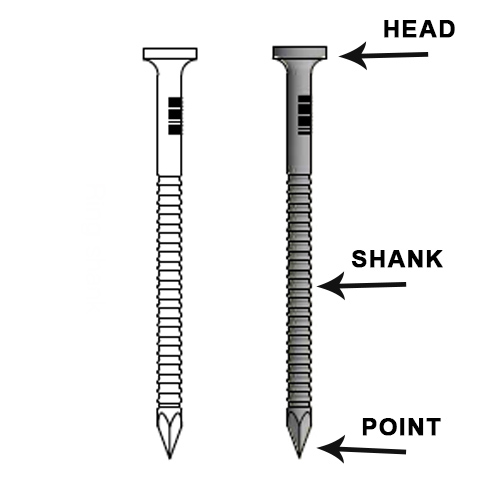
Collation angle and type: Confirm the nailer’s specified angle, commonly 15° for wire-collated coil nails, and whether it accepts wire-welded or plastic-sheet collation.
Flat or conical coil: Match the magazine design and maximum coil diameter.
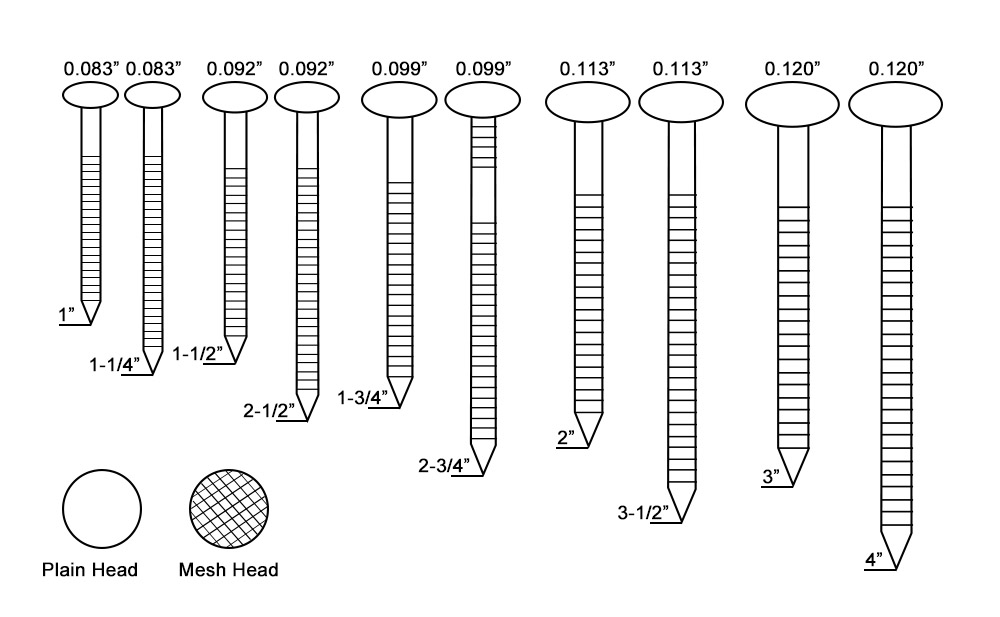
Nail length and shank diameter: Follow the joint design, material thickness, required penetration and applicable code. Do not substitute by appearance.
Head diameter and style: Roofing, siding, framing and pallet nails use different heads. Check the tool driver blade and project schedule.
Shank: Smooth shanks drive easily; ring shanks improve withdrawal resistance in many softwood joints; screw shanks are useful where high holding power is required. Use tested design values for structural work.
Point: Diamond, blunt and other points change penetration and splitting risk.
Collation quality: Specify weld strength, pitch and alignment to reduce broken coils, double feeds and jams.
Trial firing: Approve production samples in the actual nailer, substrate and operating pressure before placing a large order.

Copy the following fields into an RFQ to receive quotations that can be compared on the same basis:
Application, country of installation and local code.
Indoor or outdoor exposure, distance from the coast and any salt or chemical contact.
Wood species, preservative type, retention level and expected moisture condition.
Nailer make and model, collation angle, wire or plastic collation, and flat or conical coil.
Nail length, shank diameter, head diameter, point and smooth, ring or screw shank.
Finish route: EG, formed from galvanized wire, HDG after forming, or stainless-steel grade.
Coating standard or class and minimum average or local thickness.
Salt-spray method, hours, red or white-rust endpoint, allowed affected area and whether the cut point is excluded.
Required documents: material certificate, coating-thickness report, salt-spray report, dimensional inspection and lot traceability.
Coil quantity, box quantity, palletization, moisture protection, labels and destination shipping conditions.
A useful order description could read:
15° wire-collated coil nails, flat coil, 2.5 × 50 mm, full round head, ring shank; hot-dip galvanized after forming to ASTM A153/A153M Class D; minimum average coating thickness 43 μm and minimum individual thickness 36 μm; finished-nail neutral salt spray per ASTM B117 for 500 hours with no red rust on the head or shank; lot-specific thickness and salt-spray reports required; compatibility sample to be approved in the named nailer before production.
No. Regular EG coil nails are primarily a dry-interior or protected-service product. For exterior work, specify a verified heavy coating such as post-formed HDG to ASTM A153/A153M Class D, unless the project requires stainless steel or another approved system.
Not necessarily. You must compare the test method, failure endpoint, sample condition and coating system. Salt-spray hours are useful for production comparison but do not translate directly into outdoor years.
They should not be treated as equivalent to HDG. Copper-based preservatives can accelerate steel and zinc corrosion. Use the fastener specified by the wood treater, project code and connector manufacturer—commonly HDG Class D or stainless steel.
For severe chloride exposure, salt splash, docks and oceanfront construction, Type 316 stainless steel is normally preferred. Type 304/305 may be suitable for less severe wet exposure, subject to the project specification. Avoid mixing stainless fasteners with galvanized connectors because dissimilar-metal contact can accelerate zinc loss.
Appearance is only a clue. EG is commonly smooth and bright, while HDG is often duller and rougher, but passivation, quenching and production methods can change the appearance. Use the certificate and coating measurement for acceptance.
No. Check the angle, collation material, flat or conical coil, maximum coil diameter, nail length, shank diameter and head size against the nailer manual. Run a production sample before ordering in volume.
Choose galvanized coil nails by exposure and evidence, not by finish name alone. EG 3–5 μm is economical for dry indoor production; heavy EG 8–12 μm adds protection in sheltered humid service; verified HDG with approximately 43 μm minimum average coating is the normal starting point for many exterior and treated-wood applications. Move to stainless steel when chloride exposure, wood chemistry, visible staining or replacement risk makes galvanized carbon steel an uncertain choice.
For an accurate quotation, send KYA the application, environment, wood treatment, nailer model, nail dimensions, coating standard and required test endpoint. A matched specification makes price comparisons meaningful and helps the delivered coil nails feed correctly and last as intended.